
How to Validate a Local Service Business Idea Before You Quit Your Job
August 31, 2026 · 8 min read

Local service businesses fail for a different reason than most startups. The idea itself is rarely the problem: people need their homes cleaned, their pets walked, their kids tutored, their yards maintained. The problem is that demand for a service is intensely local, and the online research habits that work for validating a SaaS product or an ecommerce brand mostly do not transfer, because a Reddit thread from a stranger three states away tells you nothing about whether your specific neighborhood needs another dog walker.
This guide covers how to validate a local service business, cleaning, tutoring, pet care, home repair, personal training, or anything similar, before you invest savings, quit a job, or sign a lease, using the same public-complaint mindset that works for digital products, adapted for a market that is defined by geography first and category second.
Why generic market research fails local service businesses
National search volume and broad market size figures are close to meaningless for a local service. A city of two million people with a thousand searches a month for pet sitters is a completely different opportunity than a suburb of thirty thousand with the same relative demand, and neither number tells you whether the three existing pet sitters in your specific area are already meeting that demand well. The unit of analysis has to be your actual service radius, not a category, which means the research has to be narrower and more manual than a typical validation pass, even though the underlying question, is this pain real and unmet, stays the same.
Step 1: find where your specific area already complains
Local complaints cluster in predictable places: neighborhood Facebook groups, the local subreddit if your city has one, Nextdoor threads, and the Google reviews and comments left for the handful of competitors who already exist in your area. Search those places for the service category plus words like recommend, anyone know, or looking for. A thread where three or four different neighbors ask for a recommendation and nobody has a confident answer is a much stronger local demand signal than any national statistic, because it shows real people, in your actual market, currently unable to solve the problem themselves.
Step 2: read every review of your local competitors, especially the three-star ones
One and two-star reviews often describe a single bad experience that is not representative. Three-star reviews are usually the most useful: not angry enough to be an outlier complaint, not glowing enough to be marketing, just an honest account of what the existing service gets right and what it consistently gets wrong. Read every review for the two or three closest existing competitors in your specific service area, not competitors in general, and note anything that repeats: always running late, hard to reach for rescheduling, inconsistent quality between visits, prices that jumped without warning. A complaint that repeats across multiple reviews of the same local business is a specific, addressable gap, not a one-off bad day.
Step 3: check whether the complaint is about the service category or about specific operators
This distinction decides whether you have a real opportunity or a reason to pick a different category entirely. If reviews describe frustration with lateness, poor communication, and inconsistent quality across every competitor in your area, that is an operational gap you can fix by simply running a more reliable business, which is a genuinely strong starting position for a local service, since reliability is often easier to control than acquiring an entirely new customer base. If instead the complaints are about the service itself being expensive or unnecessary regardless of who provides it, that points toward weak underlying demand in your specific area, and no amount of operational excellence will fix a market that does not actually want to pay for the category.
Step 4: confirm people already pay for a partial or adjacent version
The clearest sign a local service has real demand is evidence that people already pay someone, even informally, to solve part of the problem. A neighborhood Facebook post asking if anyone's teenager wants to walk dogs for cash, a Nextdoor thread full of people trading recommendations for a cleaner who works freelance, or a competitor with a long waitlist despite mediocre reviews, all point to a market that is already spending money, just not necessarily with a business built to serve it well. Waitlists are an especially strong signal: a service with more demand than the existing providers can handle is close to the best validation a local business can find before opening.
Step 5: size the market honestly using your actual radius
Once you have a shortlist of real, repeating complaints, estimate the market using your actual service radius rather than city-wide or national numbers. Count the realistic number of households or businesses within a reasonable drive of your base of operations, estimate what share plausibly needs the service based on category norms, and multiply by a conservative price point. This number will almost always be smaller and more sobering than a national market-size figure, and that is the point: a local service business needs a market that is real and reachable, not one that merely sounds large in a pitch.
The build-or-skip decision for a local service idea
Before committing, you should be able to answer with evidence specific to your area. Do multiple neighbors or local posts show unanswered demand for this service? Do reviews of existing local competitors repeat the same operational complaint, one you could plausibly fix by running a more reliable business? Is there evidence, a waitlist, an informal cash market, a recommendation thread with no good answer, that people already pay for something close to this? And does your honest, radius-based market size support enough customers at a sustainable price? Four yes answers justify a small pilot, a handful of real customers acquired the way you plan to acquire them long term, before any larger investment in equipment, a lease, or leaving other income behind.
Frequently asked questions
How is validating a local service business different from validating a SaaS or ecommerce idea?
Local service demand is defined by geography first. National search volume, Reddit threads from other regions, and broad market-size figures mostly do not apply, because what matters is whether people in your specific service radius have unmet demand right now. Research has to focus on local Facebook groups, Nextdoor, local subreddits, and reviews of the actual competitors operating in your area.
What is the strongest signal that a local service business idea will work?
A waitlist or an informal cash market for the service in your specific area is the strongest signal, since it shows people are already paying for something close to what you plan to offer and existing providers cannot keep up. Repeating operational complaints, lateness, poor communication, inconsistent quality, across reviews of every local competitor is the second strongest, since it points to a fixable gap rather than weak underlying demand.
How do I know if a complaint about a local competitor is really an opportunity?
Check whether the complaint is about how the service is delivered (late, hard to reach, inconsistent) or about the service category itself being unwanted or overpriced. Delivery complaints that repeat across multiple competitors are addressable by running a more reliable business. Category-level complaints usually signal weak demand that better operations cannot fix.
Should I estimate market size for a local service business the same way as a national product?
No. Use your actual service radius, the realistic number of households or businesses within a reasonable distance of your base of operations, rather than city-wide or national figures. This produces a smaller, more honest number, which is the point: a local service business needs a market that is genuinely reachable, not one that only sounds large in a spreadsheet.
More articles
 Strategy
How to Use Competitor Analysis to Find a Market Gap (Not Just a Feature List)
Most competitor analysis produces a feature comparison table nobody acts on. Here's how to run competitor analysis that surfaces an actual gap, an underserved segment or complaint incumbents structurally can't fix, using public reviews and complaints instead of marketing pages.
Read article →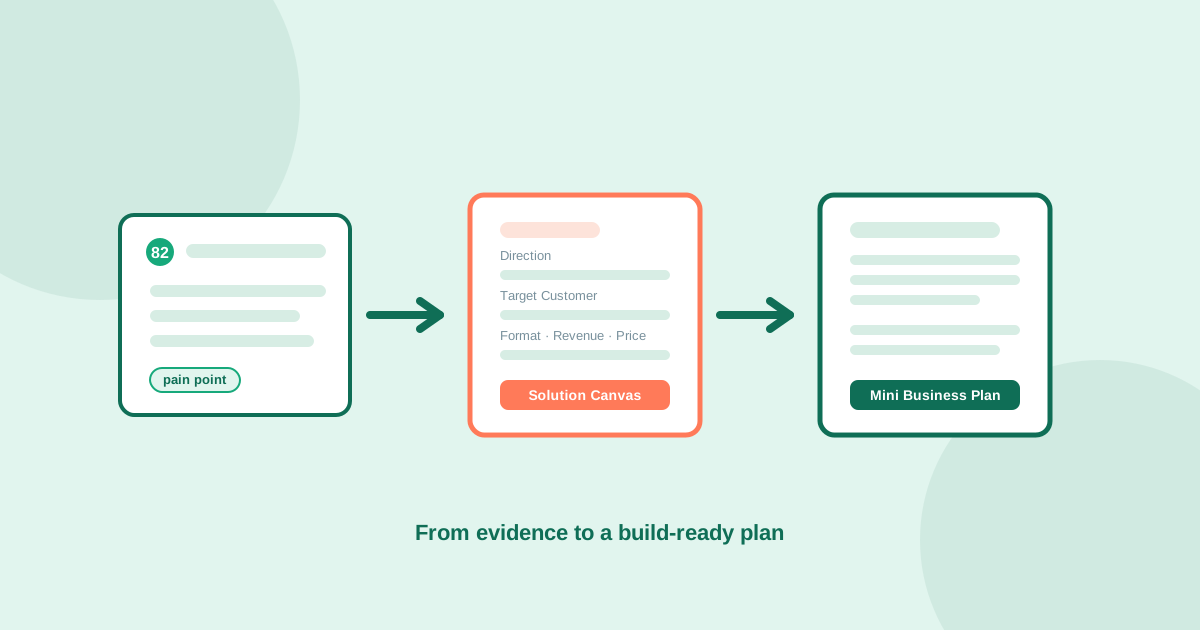 Strategy
From Pain Point to Product Plan: How to Use a Solution Canvas and a Mini Business Plan
Finding a validated pain point is only half the job. Here's how to turn a ranked pain point into a concrete Solution Canvas and a one-page Mini Business Plan you can actually act on, instead of staring at a spreadsheet of quotes wondering what to build.
Read article →