
Best GummySearch Alternatives in 2026 (Access Ends 30 November)
Updated September 10, 2026 · 11 min read
If you are reading this, you already know GummySearch is gone. What most people miss is that there are two dates, and the second one is the one that should be in your calendar.
GummySearch stopped taking new customers on 30 November 2025 after it could not agree a commercial licence for Reddit's Data API. If you were already a paying customer, you kept access through the end of your billing period, and annual plan holders were carried into late 2026. That runway ends on 30 November 2026. On 1 December 2026, user data is permanently deleted.
So if you are still logging in, you have weeks, not months, and anything you have not exported goes with it. This guide is written for that moment: what each remaining option actually does, what it costs, and which half of the old GummySearch job it replaces.
How this list was put together
Pricing and features below were read from each tool's own public pricing and product pages in September 2026, not from other listicles. Where a tool publishes tiers, the real numbers are quoted. Where something is unclear on the vendor's site, this guide says so rather than guessing.
One disclosure up front: UserConcern, listed eighth, is our product. It is included because it belongs in the comparison, and it is described with the same honesty as the rest, including the jobs it does not do. If you want Reddit monitoring specifically, several tools further up this list are a better fit, and the guide says so plainly.
First, decide which job you are replacing
GummySearch was really two products sold as one, and this is why generic 'best alternative' lists tend to disappoint. The first job was monitoring: watch Reddit for keywords, surface threads worth replying to, catch people asking for a tool like yours. The second job was research: read a whole audience, find the recurring complaints, and decide whether a problem is worth building for.
Almost every tool below is excellent at one of those and mediocre at the other. Pick the job first and the shortlist gets very short.
1. RedShip - closest replacement for Reddit monitoring
RedShip reads your website, works out what you sell, and turns that into keywords worth watching across all of Reddit. It scores posts for relevance, flags Reddit threads that rank on Google for your keywords, tracks whether you are mentioned in ChatGPT, Perplexity and Gemini answers, and watches competitor threads for switching intent.
Pricing: Founder at $29/month billed yearly (1 website, 10 keywords, 3 competitors, 1 seat) and Company at $49/month billed yearly (3 websites, 30 keywords, 10 competitors, 3 seats).
Best for: founders who used GummySearch to find conversations to join. Weakness: it is Reddit-only, which is precisely the dependency that killed GummySearch.
2. Syften - widest community coverage for keyword alerts
Syften monitors roughly twenty platforms: Reddit, Hacker News, X, Bluesky, Mastodon, GitHub, Stack Exchange, Dev.to, Lobste.rs, Indie Hackers, Product Hunt, YouTube, podcasts, newsletters, Slack communities and the public web. Alerts arrive by email, Slack, RSS, webhook or API within minutes.
Pricing: Entry $29.95/month (3 community filters, 100 daily results), Standard $49.95/month (20 filters, 200 daily results, Slack, AI filtering, API) and Pro $119.95/month (100 filters, 500 daily results, unlimited archive, webhooks, MCP). All tiers include a 14-day trial with no card.
Best for: developer-tool and indie founders whose audience lives outside Reddit as much as on it. Weakness: it alerts, it does not analyse. You still read everything yourself.
3. F5Bot - free, and still the best price in the category
F5Bot emails you when your keywords appear on Reddit, Hacker News or Lobsters, usually within minutes. It has done one job well for years.
Pricing: free with keyword alerts and email notifications. Silver is $9.99/month for 20 keywords and advanced filtering. Gold is $49.99/month for 200 keywords, RSS and JSON feeds, AI filtering and Slack or Discord delivery.
Best for: anyone who wants alerts and nothing else. If your GummySearch usage was really just 'tell me when someone mentions X', start here and spend nothing. Weakness: three sources, no analysis, no research layer.
4. Reddinbox - AI research across five platforms
Reddinbox is closer to the research half of GummySearch. You ask a research question and it returns structured, citable insights from Reddit, X, Bluesky, Hacker News and Facebook, filtering out spam, bots and AI-generated noise. Quora is listed as coming soon.
Pricing: Starter $39/month for roughly 100 agent conversations and 3 Market Briefs, Pro $99/month for roughly 266 conversations and 5 briefs. Both offer free trials without a card, and annual billing gives two months free.
Best for: people who used GummySearch to understand an audience rather than to find threads. Weakness: usage is metered in conversations, which is harder to predict than a search count.
5. Prowlo - for people who run AI agents
Prowlo is an MCP server that gives AI agents access to social data. It consolidates Reddit, X, Hacker News, Mastodon and RSS into one searchable dataset with semantic search, and drafts responses for a human to review. It is read-only by design: agents never post on their own.
Pricing: Standard $19/month or $190/year, with 25 watchers checked hourly, 20 daily Reddit-wide keyword searches, and access from Claude, Cursor and Cline. Scale and Team tiers exist for heavier workloads without public pricing. 14-day trial, no card.
Best for: anyone already working inside Claude or Cursor who wants social data in the same place. Weakness: if you do not use AI agents, most of what you are paying for is inaccessible.
6. Brand24 - the enterprise option
Brand24 is full social listening: 16+ channels including Reddit, Facebook, Instagram, X, LinkedIn, TikTok, YouTube, Quora, blogs, news, podcasts and review sites, with sentiment analysis, engagement metrics and influencer tracking.
Pricing: Individual $199/month billed annually ($249 monthly) for 3 keywords and 2,000 mentions, rising through Team, Pro and Business at $599/month annually for 25 keywords and 100,000 mentions. Enterprise starts around $1,499/year. 14-day trial, 30-day money-back guarantee.
Best for: companies with a brand to protect and a budget to match. Weakness: it is built for PR and marketing teams tracking an existing brand, not for a founder deciding what to build. At roughly seven times the price of most tools here, it is the wrong shape for pre-launch validation.
7. Hive Index - free, and solves a different problem
Hive Index is a directory of more than 5,600 online communities across 286 topics and 36 platforms. It does not monitor anything. It tells you where a given audience actually gathers, which is the question you have before you know what to monitor.
Pricing: free to browse and free to list, with optional paid placement.
Best for: the first hour of research in an unfamiliar market. Weakness: it is a map, not a tool. Pair it with something from this list.
8. UserConcern - multi-source validation (this is our product)
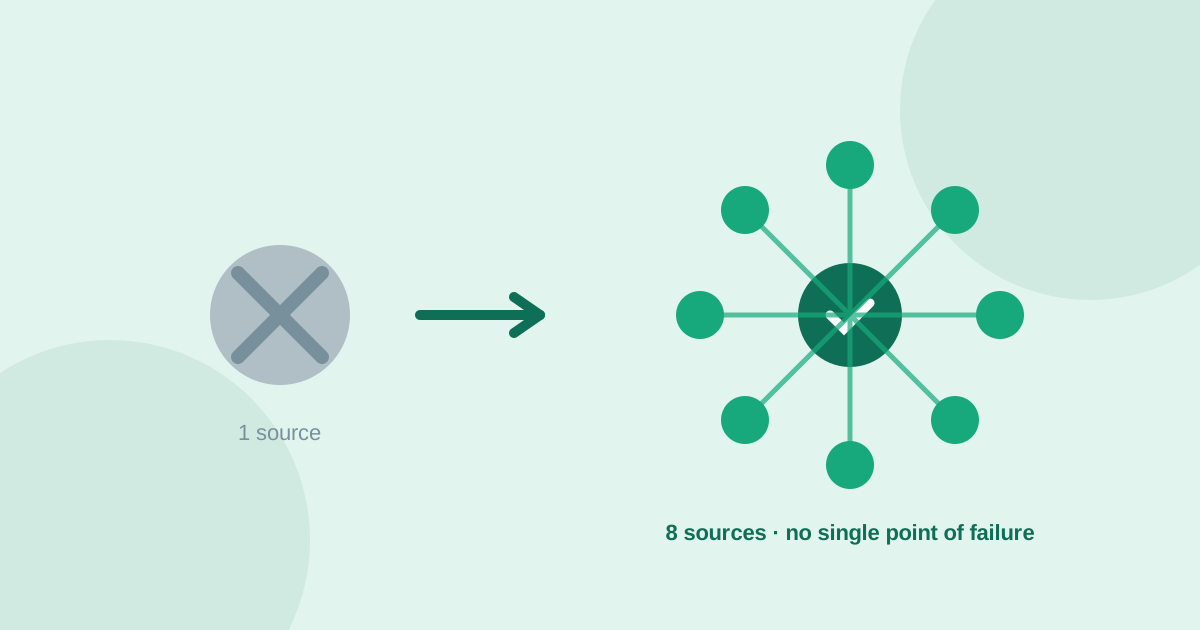
UserConcern replaces the research half of GummySearch and deliberately not the monitoring half. One search cross-checks eight sources - Reddit, Amazon reviews, YouTube, TikTok, X, Quora, Google Trends and AI answers - in nine languages and sixteen regions, then returns ranked pain points with an opportunity score, real quotes linked back to the original thread or review, and a build-or-skip verdict.
The design decision behind it is the reason GummySearch is not here any more: a pain point that only appears on one platform is an anecdote, and a tool that only reads one platform can be switched off by one company's policy change.
Pricing: Free with 3 searches a month and no card, Pro $27/month or $270/year for unlimited searches, competitor analysis, review intelligence, solution canvas, business plan and PDF export, and Investor $97/month.
Best for: deciding whether a problem is worth building for, especially in non-English markets that English-only tools cannot see. Weakness: it is not a monitoring tool. It will not tell you that someone mentioned your brand an hour ago, and if that is what you need, RedShip, Syften or F5Bot are the right answer.
Side by side
| Tool | Sources | Entry price | Replaces which job |
|---|---|---|---|
| RedShip | Reddit only | $29/mo yearly | Monitoring |
| Syften | ~20 communities | $29.95/mo | Monitoring |
| F5Bot | Reddit, HN, Lobsters | Free | Monitoring |
| Reddinbox | 5 platforms | $39/mo | Research |
| Prowlo | Reddit, X, HN, Mastodon, RSS | $19/mo | Monitoring, via AI agents |
| Brand24 | 16+ channels | $199/mo yearly | Brand monitoring |
| Hive Index | 5,600+ communities | Free | Finding where to look |
| UserConcern | 8 sources, 9 languages | Free, then $27/mo | Research and validation |
Which one should you choose
If you want alerts and nothing else, start with F5Bot on the free tier. It costs nothing and it may be all you were using GummySearch for.
If you replied to Reddit threads to find customers, RedShip is the closest thing to what you lost, and Syften is the better pick if your audience is spread across Hacker News, GitHub and Indie Hackers as much as Reddit.
If you used GummySearch to decide what to build, you want the research half: Reddinbox if you like an AI agent you converse with, UserConcern if you want cross-source validation, an opportunity score and a verdict, and coverage of markets that are not in English.
If you have a brand, a team and a budget, Brand24 is the grown-up option and priced accordingly.
And if you are still logged into GummySearch: export what you have before 30 November 2026. On 1 December it is deleted, and no tool on this list can get it back for you.
Frequently asked questions
When exactly does GummySearch stop working?
There are two dates. It closed to new customers, upgrades and renewals on 30 November 2025. Existing paid customers keep access until the end of their billing period, and annual plan holders retain access until 30 November 2026. All user data is permanently deleted on 1 December 2026.
Why did GummySearch shut down if it was profitable?
It could not secure a commercial licence for Reddit's Data API. By the founder's public account the product was profitable, at roughly $35,000 in monthly recurring revenue with more than 10,000 paying customers over its lifetime. It was built entirely on one data source, so one platform's policy decision ended it regardless of how well the business was doing.
What is the closest direct replacement for GummySearch?
It depends which half you used. For finding Reddit threads to engage with, RedShip is the closest single replacement, with Syften covering more communities and F5Bot doing the basics free. For understanding an audience and validating whether a problem is worth solving, Reddinbox and UserConcern are the closer fit. No single tool rebuilt both halves.
Can I export my GummySearch data?
Check your account for the export options GummySearch provides during its wind-down, and do it before 1 December 2026, when data is deleted. Whatever you export, the practical move is to re-run your key topics on a new tool, because saved results from a single-source tool are a snapshot, not an ongoing feed.
Will the same thing happen to these alternatives?
Any tool that depends on one platform's API carries the same risk, and several on this list are Reddit-only. That is not a reason to avoid them, but it is a reason to prefer month-to-month billing over annual with single-source tools, and to weight multi-source options more heavily if you are building a workflow you intend to keep for years.
Want the short, side-by-side version? See the UserConcern vs GummySearch comparison page.
More articles
 Market Research
How to Identify Customer Pain Points: 7 Methods That Actually Work
Customer pain points are the raw material of every successful product. Here are 7 practical methods to find them, from free manual research to AI-powered analysis.
Read article → Market Research
How to Find Customer Pain Points on Reddit (Step-by-Step Guide)
Reddit is the largest honest focus group on earth. Here's a step-by-step method to extract real customer pain points from it, plus the trap that catches most researchers.
Read article →