
Best PainOnSocial Alternatives in 2026 (For When Reddit Alone Isn't Enough)
July 24, 2026 · 8 min read
If you are comparing PainOnSocial against other options, you are probably trying to answer one of two questions: is there a version of this tool that costs less or scans more, or does a Reddit-focused pain point tool actually answer the question you have, which might be broader than Reddit. Those are different questions, so this comparison keeps them separate instead of blurring them into a single features table.
What PainOnSocial actually does
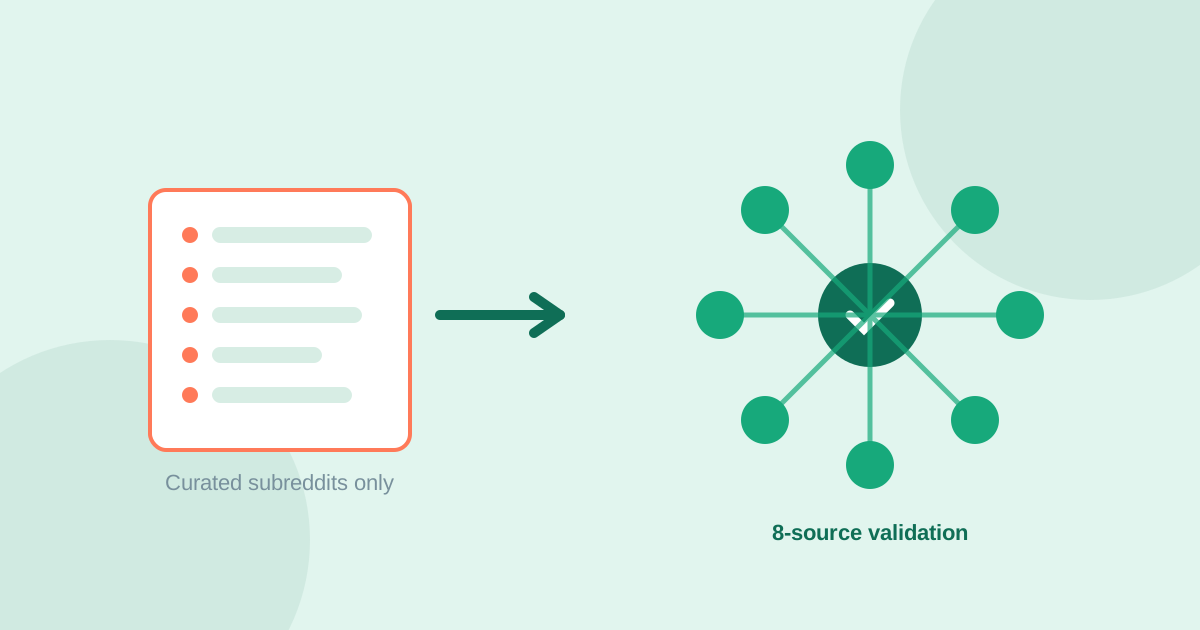
PainOnSocial searches Reddit specifically, and it does that job with real craftsmanship. It analyzes discussions across a curated list of more than 30 subreddits, uses AI to score pain points by frequency and intensity, and backs every result with evidence: real quotes, permalinks to the original discussion, and upvote counts so you can gauge community agreement at a glance. Beyond discovery, it also generates AI solution ideas and suggested target audiences for each pain point, which pushes the tool a step past pure research into early ideation. The paid Professional tier runs $49/month and includes 15 scans per day, up to 5 subreddits per scan, a choice of 7, 30 or 90-day timeframes, and 20 to 25 pieces of evidence per pain point, with a free trial to test the workflow before paying.
For anyone doing Reddit-first product research, that is a genuinely well-built, narrow tool. The curated subreddit list alone saves real time: instead of guessing which of Reddit's thousands of communities are worth searching, someone has already done that filtering for you. The upvote-count signal is something a generic multi-source scraper cannot replicate as cleanly, because it is native to how Reddit ranks conversation, not an approximation of social proof.
Where it's genuinely useful
If your workflow is already Reddit-centric — you are validating an idea you expect to launch and market through Reddit communities, or your audience is known to congregate there — a tool built entirely around Reddit's structure has real advantages. Upvote counts double as a rough popularity filter. Curated subreddit lists mean less time spent figuring out where your audience even talks. AI-generated solution ideas give you a starting point for ideation rather than a blank page. None of that is a knock against the tool; it is what a well-executed single-platform product looks like.
Where a single-source tool hits a ceiling
The limitation is architectural, and it is the same one that eventually catches every tool built on one platform, regardless of how well it executes: everything it surfaces lives inside Reddit, and inside whichever subset of Reddit its curators chose to include. A pain point that scores highly across five curated subreddits tells you those five communities are upset about something. It does not tell you whether that frustration exists outside Reddit's demographic, which skews toward younger, English-speaking, technically comfortable users compared to the broader population of potential customers.
There is also a practical ceiling built into the plan structure itself: 15 scans a day and up to 5 subreddits per scan means someone, at some point, decided which communities are in scope for your research. That curation is a feature when the list matches your niche well, and a blind spot when it does not, because you cannot search a subreddit that was never added to the list, and you have no way of knowing what a search of the other 99% of Reddit — let alone the internet outside Reddit — would have shown you.
This is not a hypothetical risk. It is the exact structural weakness that ended GummySearch, once the best-known Reddit research tool on the market: a profitable, ten-thousand-customer product that still could not survive a single change to Reddit's API terms, because there was nothing underneath it but Reddit. A tool does not need to fail outright for this risk to matter day to day. Even while fully operational, a Reddit-only tool can only ever answer "what is Reddit saying," and that is a narrower question than "is this a real market."
GummySearch itself is no longer an option: active accounts lose access on 30 November 2026 and the data is deleted the next day. What to use instead of GummySearch compares eight tools on price and coverage.
What to use instead, depending on the job
If your job is specifically Reddit research — finding language for Reddit-native marketing copy, understanding a handful of communities deeply, generating quick solution ideas to react to — PainOnSocial's curated, evidence-linked approach is a reasonable, well-built choice, and switching away from it for that specific job would not obviously improve your results.
If your job is deciding whether a pain point is real enough to build a business around, a single platform cannot answer that question by design, no matter how well it scores what it finds. A pain point that only shows up on Reddit might be a real, underserved market. It might also be a quirk of Reddit's particular culture and complaint style. The tool cannot tell the difference, because telling the difference requires checking somewhere else.
Where UserConcern fits
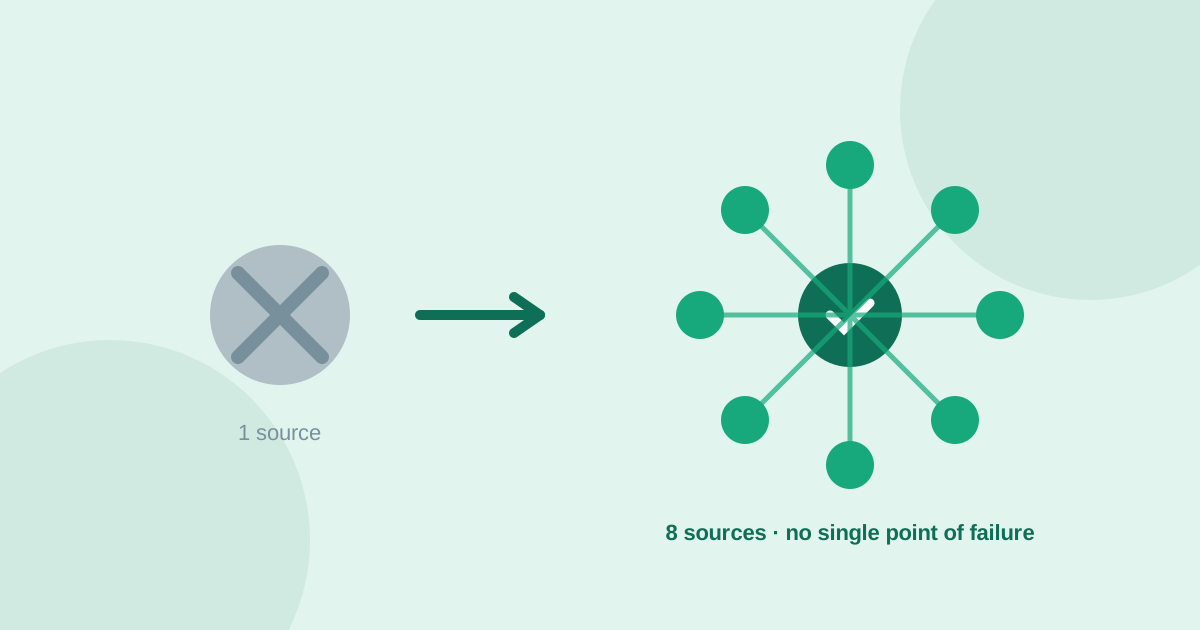
UserConcern is built for that second job. One search cross-checks 8 sources — Reddit, Amazon reviews, YouTube, TikTok, Twitter/X, Quora, Google Trends and AI answers — in about 60 seconds, in 9 languages across 16 regions, and returns ranked pain points with the original quotes linked back to their source, an opportunity score, and a build-or-skip verdict. There is no subreddit list to curate and no ceiling on which community you can check, because the architecture does not depend on any single platform's willingness to keep granting access, and it does not depend on someone else having pre-selected which corners of the internet are worth your attention.
The honest recommendation: if you already know Reddit is where your audience lives and you want deep, evidence-backed research inside that platform, a tool purpose-built for Reddit will serve you well. If you are still trying to find out whether a pain point is real before you spend weeks building around it, cross-source validation is the step that answers a question Reddit alone cannot, and it is worth running before, not instead of, deeper platform-specific research.
Frequently asked questions
What does PainOnSocial do?
PainOnSocial searches a curated list of over 30 subreddits, scores pain points by frequency and intensity using AI, and backs each result with real quotes, permalinks and upvote counts. Its Professional plan is $49/month for 15 scans per day, up to 5 subreddits per scan, and 20-25 pieces of evidence per pain point, plus AI-generated solution ideas.
Is PainOnSocial only for Reddit?
Yes. PainOnSocial's research, scoring and evidence all come from Reddit, specifically from a curated subset of subreddits. That makes it strong for Reddit-native research, but it cannot confirm whether a pain point exists outside Reddit's userbase, since it has no access to other platforms by design.
What is the main difference between PainOnSocial and UserConcern?
PainOnSocial scores pain points within curated Reddit communities. UserConcern cross-checks a pain point across 8 sources — Reddit, Amazon reviews, YouTube, TikTok, Twitter/X, Quora, Google Trends and AI answers — so a finding has to hold up outside of Reddit's culture and demographics before it counts as validated demand, not just Reddit-validated demand.
Should I use a Reddit-only tool or a multi-source tool for validation?
It depends on what you already know. If you have already confirmed your audience lives on Reddit and you want to go deep there, a Reddit-focused tool is a good fit. If you have not yet confirmed the pain point is real, a multi-source check first prevents you from mistaking one platform's culture for a genuine market — the mistake that is easiest to make when a tool only ever shows you one source's version of the truth.
More articles
 Market Research
Best GummySearch Alternatives in 2026 (Access Ends 30 November)
GummySearch closed to new customers in November 2025, and existing users lose access on 30 November 2026 with all data deleted the next day. Eight alternatives compared on real pricing, real sources, and which half of the job each one actually replaces.
Read article → Market Research
How to Identify Customer Pain Points: 7 Methods That Actually Work
Customer pain points are the raw material of every successful product. Here are 7 practical methods to find them, from free manual research to AI-powered analysis.
Read article →