
How to Validate a Crowdfunding Product Idea Before You Launch a Kickstarter Campaign
September 10, 2026 · 8 min read

Most product launches fail quietly. A slow-selling item sits on a shelf or a store page, gets marked down, and eventually gets forgotten. A crowdfunding campaign does not get that mercy. The funding page, the backer count, and the final percentage stay visible forever, and a campaign that stalls at 12 percent funded is a public result, not a private lesson. That difference alone should change how a founder validates the idea before the launch date is set, not after.
This guide applies the same public complaint mining that works for product and SaaS validation to the specific bet a crowdfunding launch makes: that enough strangers will pay in full, months before delivery, for something that does not exist yet and might arrive late. That is a much harder yes than a normal purchase decision, and it deserves evidence gathered before the campaign page is designed, not during the thirty days it is live.
Why crowdfunding validation is a different problem
A regular product only needs enough buyers to be profitable. A crowdfunding campaign needs enough buyers, in a fixed window, who are willing to pay upfront, sight unseen, for a delivery date that will almost certainly slip. That combination filters out a huge share of otherwise interested buyers and rewards only ideas with real urgency behind them. A mild improvement over what already exists rarely clears that bar. A frustration people already describe as ridiculous that nobody has fixed, that is much closer to what gets funded in the first 48 hours, which is also the window that decides whether a campaign's own momentum carries it the rest of the way.
The question that matters: will they pay before it exists
The real validation question is not does this problem exist, it is will the specific people who have this problem accept the crowdfunding deal: pay now, wait months, accept some delivery risk. Backers who fund hardware campaigns are usually early adopters who already own three versions of the product category and are annoyed by all of them in slightly different ways. Finding that specific annoyance, in their own words, is worth more than a broad survey saying people like the idea.
Where to find pre-launch demand signals
The complaints that predict a crowdfunding campaign's outcome live in a few specific places. Reddit threads asking does anyone make a version of this that fixes a named flaw are a direct signal, since the asker is already looking for a solution and would plausibly pay for one today. Amazon reviews of the closest existing products, filtered to two and three stars rather than one star, describe a specific design flaw in a product people otherwise kept and used, which is a stronger signal than a one star review describing a product that simply broke. YouTube comments under review or unboxing videos of similar products often contain requests for a feature the reviewed product lacks, phrased as a direct wish rather than a vague complaint. Older Kickstarter and Indiegogo comment sections for similar past campaigns, both funded and failed, are an underused source: backers who left comments after a late or disappointing delivery describe exactly what they wish the campaign had done differently, which doubles as a list of mistakes to avoid.
Reading complaints for crowdfunding-specific signals
Not every valid complaint predicts crowdfunding success. Look specifically for price tolerance language, phrases like I would pay double for one that actually works, and for repeat-purchase frustration, people mentioning they have bought and returned multiple versions of a product trying to find one that solves a single flaw. Both are stronger predictors than general enthusiasm, because they show the person has already spent money chasing this problem and would recognize a real fix immediately. Vague positivity, such as that would be cool, rarely converts into a pledge, since pledging requires a stranger to trust a campaign page enough to pay before the product exists.
A worked example: a portable induction cooktop for van life
Reddit van life and overlanding communities repeatedly describe the same frustration: portable induction cooktops sold for home kitchens draw too much power for a small battery bank, or they are too large to store in a vehicle with no dedicated counter space. Amazon reviews of existing portable induction burners, read at the three star level, mention exactly this: works fine at home, drains our van battery in twenty minutes, too bulky to store anywhere useful. That is not a request for a cheaper cooktop. It is a request for a specific redesign, low draw, compact footprint, that the current category has not addressed, and it appears independently across Reddit threads, Amazon reviews, and YouTube comments on van build videos, which is exactly the cross-source confirmation a crowdfunding pitch should be built around before a single render is designed.
Before you build the campaign page
Run a short pre-launch check before committing to campaign copy and a video shoot. Confirm the complaint appears independently across at least three sources, not just one enthusiastic subreddit. Build a small waitlist or landing page using the exact language from the complaints you found, and watch whether strangers who match the profile sign up without being told who you are. Search past campaigns in the same category on Kickstarter or Indiegogo and read what backers said went wrong, since a category with a recent, well-documented failure needs a campaign page that directly answers the reason that failure happened, not one that ignores it.
The fulfillment trap most guides skip
Validation for crowdfunding does not end at will people pledge. Read reviews and comments left by backers of funded campaigns in your category after delivery, not just before. A recurring pattern of complaints about delays, quality that did not match the prototype video, or unresponsive updates during production tells you what backers in this specific category already expect to go wrong, and what your own campaign page needs to address directly, with a realistic timeline and a visible manufacturing plan, to avoid inheriting a trust problem you did not personally create.
A crowdfunding launch only gets one real shot at its funding window, which makes evidence gathered beforehand worth far more than evidence gathered by watching the campaign underperform in real time. Reading Reddit, Amazon reviews, YouTube comments and past campaign histories for the same specific complaint, confirmed across sources rather than assumed from one enthusiastic thread, is the difference between a campaign page built on a guess and one built on a frustration real backers have already described in their own words. UserConcern can run that same cross-source check across 8 sources in about 60 seconds, before you spend a production budget on a prototype video.
Frequently asked questions
Why do crowdfunding campaigns fail even when the product idea is good?
Most crowdfunding failures are not product failures, they are demand-timing failures: not enough of the specific people who feel this frustration were reached in the fixed funding window, or the pitch described a mild improvement rather than a fix for a frustration backers already describe as urgent. Validating the specific complaint before launch, not just the general product category, is what prevents this.
How is validating a crowdfunding idea different from validating a normal product idea?
A normal product only needs enough buyers to be profitable over time. A crowdfunding campaign needs enough buyers willing to pay in full, upfront, before the product exists, within a fixed window, and to accept the real risk of delivery delays. That bar is higher, so the underlying complaint needs to show real urgency and price tolerance, not just general interest.
Where should I look for demand signals before launching a Kickstarter or Indiegogo campaign?
Reddit threads asking if a product with a specific fix already exists, two and three star Amazon reviews of the closest existing products, YouTube comments under review videos requesting a missing feature, and comment sections on past crowdfunding campaigns in the same category, both funded and failed. Each source reveals a different layer of unmet demand and past mistakes to avoid repeating.
How do I know if people will actually pay for my idea instead of just liking it?
Look for price tolerance language such as willingness to pay more for a real fix, and repeat-purchase frustration, where people describe buying and returning multiple versions of a product chasing one specific flaw. Vague enthusiasm rarely converts into a pledge. A complaint confirmed independently across three or more sources, with money or repeat-purchase language attached, is a far stronger predictor of backer behavior.
More articles
 Strategy
How to Use Competitor Analysis to Find a Market Gap (Not Just a Feature List)
Most competitor analysis produces a feature comparison table nobody acts on. Here's how to run competitor analysis that surfaces an actual gap, an underserved segment or complaint incumbents structurally can't fix, using public reviews and complaints instead of marketing pages.
Read article →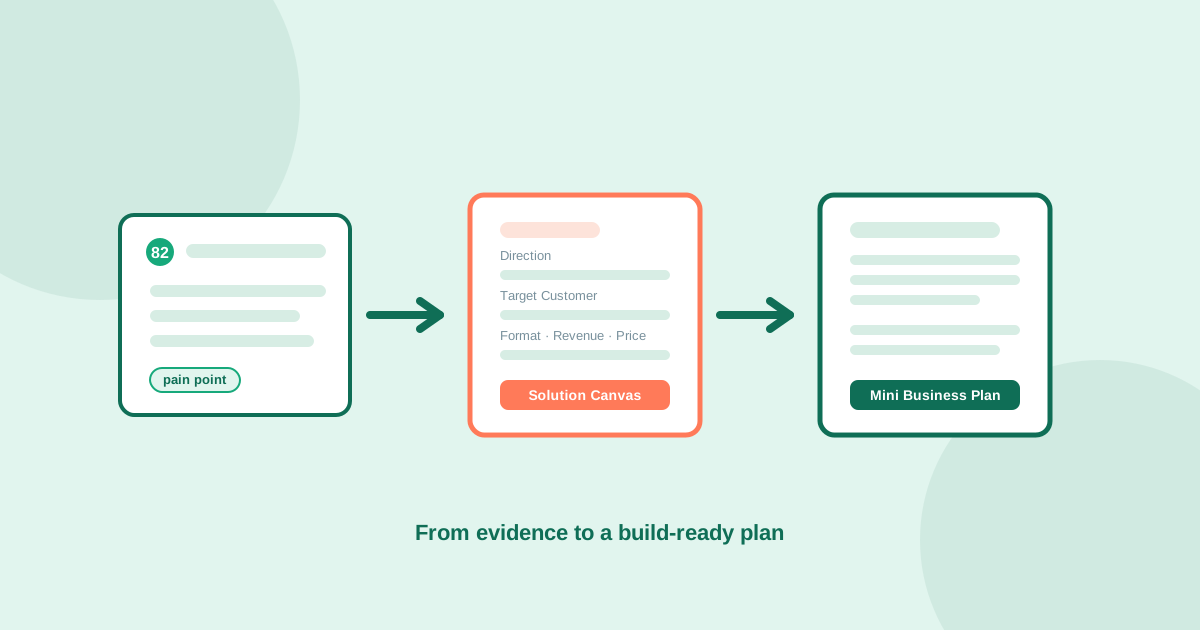 Strategy
From Pain Point to Product Plan: How to Use a Solution Canvas and a Mini Business Plan
Finding a validated pain point is only half the job. Here's how to turn a ranked pain point into a concrete Solution Canvas and a one-page Mini Business Plan you can actually act on, instead of staring at a spreadsheet of quotes wondering what to build.
Read article →