
How to Validate an AI Tool or AI Wrapper Idea Before You Build It
August 13, 2026 · 9 min read
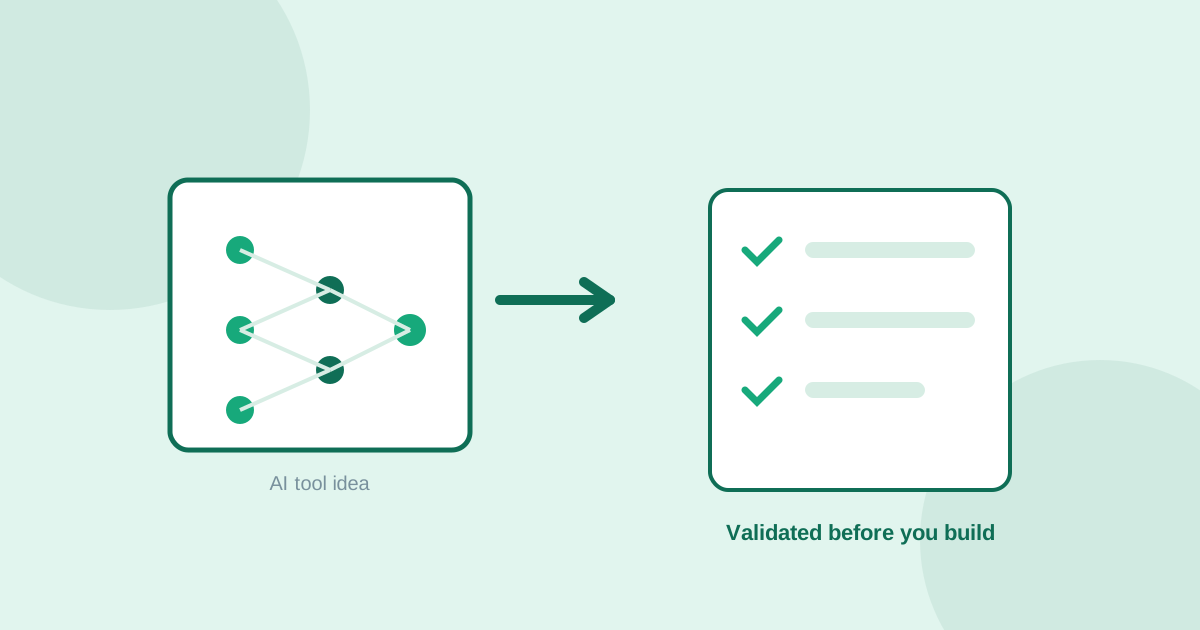
Building an AI tool has never been cheaper or faster. A working prototype that calls a foundation model's API and wraps it in a clean interface can be shipped in a weekend, sometimes in an afternoon. That is the appeal, and it is also the entire problem: if you can build it in a weekend, so can several hundred other people who searched the same keyword you did, and so can the model provider itself, in a single product update, for free, to everyone who already has an account.
That changes what validation needs to prove for an AI tool in a way it does not for most other software categories. It is not enough to confirm the underlying problem is real. You also have to confirm the problem needs more than a thin interface over someone else's model, because a thin interface is the one thing every competitor and every platform update can erase overnight.
Why most AI tool ideas fail quietly, not loudly
AI wrapper products rarely fail because nobody wanted them. They fail because the value people initially found was the novelty of an AI doing something at all, and once that novelty faded, or once ChatGPT, Claude, Gemini or another general-purpose assistant added the same capability natively, there was nothing left holding the user in your product specifically. This is the quiet failure mode: usage looks fine for a few months, then a platform update or a competitor's cheaper clone erases the differentiation almost instantly, because there was no moat beyond being first to wrap a particular prompt in a nice interface.
The two questions AI tool validation has to answer
Beyond the general question of whether a pain point is real, an AI tool idea has to clear two more specific bars. First: does the value come from something beyond the model call itself, such as a proprietary dataset, a workflow that saves genuinely significant time across multiple steps, an integration that would be painful to replicate, or domain-specific accuracy a general model cannot match out of the box? If the honest answer is that your product is a prompt and a chat window, that is a demo, not a defensible product. Second: is the underlying pain point one a general-purpose AI assistant has not already absorbed, and is unlikely to absorb in its next update? Foundation model providers ship new capabilities constantly, and a feature that seems like a clever niche use case today can become a checkbox in a settings menu within a quarter.
Where AI tool complaints actually live
Product Hunt comment sections and launch threads reveal what early adopters say once the initial excitement wears off, including the specific moment someone churned to a competitor or back to manually using ChatGPT directly. Reddit communities built around specific professions or workflows (marketing, legal, coding, customer support) contain detailed complaints about existing AI tools: hallucinated output nobody caught in time, generic results that needed heavy editing anyway, or a tool that solved one step of a process while ignoring the five steps around it. Twitter/X threads from people building or using AI tools are unusually candid about what breaks trust: confidently wrong answers, pricing that punishes exactly the usage pattern that made the tool valuable, and a lack of transparency about which underlying model is actually doing the work. G2 and Capterra reviews of existing AI products in your category show what paying business users specifically resent enough to write down, which is a stronger signal than free-tier chatter.
A concrete example: AI meeting notes tools
AI meeting notes and transcription tools are one of the most crowded categories that exists, which makes them a useful test case for this kind of research. Reading complaints across Reddit, G2 and Product Hunt threads surfaces a specific, repeated pattern: summaries that miss the one decision that actually mattered in the meeting, action items attributed to the wrong person, and a tool that transcribes accurately but still requires fifteen minutes of manual cleanup before the notes are usable. None of that is solved by a better transcription model, because transcription accuracy stopped being the bottleneck two years ago. The complaint has moved to judgment (what to include, what to omit, who owns what) which is exactly the kind of workflow-specific problem a thin wrapper cannot solve just by calling a newer, larger model.
A tool that addresses that specific gap, structured output tuned to a specific meeting type such as sales calls or engineering standups, with a learned sense of what that particular team considers a decision worth flagging, is competing on something a general-purpose assistant's default summary feature does not replicate automatically, in a category that looks saturated only until you read what current users are still annoyed about.
The build-or-skip decision for an AI tool idea
Before writing code, you should be able to answer four questions with evidence gathered from real complaints, not assumptions. Does the pain point show up independently across at least two or three sources, described with specific, workflow-level frustration rather than generic excitement about AI? Does your idea's value depend on something beyond a single model call, such as proprietary context, a multi-step workflow, or domain-specific tuning? Is there a concrete reason a foundation model provider is unlikely to absorb this exact capability into their core product within the next year, such as a need for private, customer-specific data the provider will never have access to? And have you named the cheapest possible way a competitor could copy your core loop, and confirmed your idea still has an edge even in that scenario?
Four strong answers justify building a focused prototype around the specific workflow gap you found, not a general-purpose tool competing on breadth. Weak answers on the moat questions, even with a real underlying pain point, mean the idea may be better as a feature inside an existing product, sold to an audience that already trusts you, rather than a standalone company racing a platform update to the market.
What durable AI tools tend to have in common
Across categories, the AI products that survive past the novelty phase tend to share a pattern: they own data or context a general model cannot access on its own, they save time across a multi-step workflow rather than a single prompt, and they are judged by users on accuracy within one narrow, well-understood domain rather than general capability. None of those properties are visible from a keyword search or a competitor's landing page. They are visible in what frustrated users say when a tool almost worked but did not, which is exactly the language complaint mining is built to surface. Before you build another wrapper, spend the weekend reading what people are still annoyed about in the category you are entering, not just confirming that AI-plus-your-niche is a phrase people search for.
Frequently asked questions
Why do so many AI wrapper products fail?
Most AI wrapper failures are quiet, not sudden: the initial novelty of an AI doing something at all wears off, and a foundation model provider or a cheaper clone absorbs the same capability, leaving nothing that kept users in the product specifically. Validation for an AI tool has to confirm the value comes from more than a single model call before that happens, not just that the underlying problem is real.
How is validating an AI tool idea different from validating regular SaaS?
Regular SaaS validation mainly needs to confirm a pain point is real and underserved. AI tool validation needs that plus two more checks: whether the value depends on something beyond the model call itself, such as proprietary data or a multi-step workflow, and whether a general-purpose AI assistant is likely to absorb the same capability into its core product in a future update, erasing the differentiation overnight.
Where do people complain about AI tools?
Product Hunt launch threads and comments, Reddit communities built around specific professions or workflows, Twitter/X threads from builders and users, and G2 or Capterra reviews of existing AI products in the category. Reviews from paying business users tend to reveal workflow-level frustration more precisely than free-tier social media chatter.
What makes an AI tool defensible against a platform update?
Owning data or context a general-purpose model cannot access on its own, saving meaningful time across a multi-step workflow rather than a single prompt, and domain-specific accuracy tuned to one narrow use case rather than general capability. Products built only as an interface over someone else's model, without any of these, are the most exposed when a foundation model provider ships the same feature natively.
More articles
 SaaS & Tech
How to Validate a SaaS Idea in 48 Hours (With Evidence, Not Opinions)
A step-by-step framework to validate a SaaS idea in one weekend using real customer complaints from 8 sources, with a worked example and a clear build-or-skip verdict.
Read article → SaaS & Tech
How to Validate a Personal Finance App Idea Before You Write Code
Personal finance apps carry trust and regulatory weight that most SaaS ideas don't. Here's how to validate the pain point, the trust gap and the willingness to switch before you build a budgeting, saving or investing app.
Read article →