
How to Validate a SaaS Idea in 48 Hours (With Evidence, Not Opinions)
Updated July 12, 2026 · 12 min read
Founders are told to talk to customers before building. That advice is correct, and often impractical at speed. Scheduling interviews takes days. Responses skew polite. Cold outreach burns energy. Meanwhile, public forums fill with unfiltered complaints from people describing exactly what they wish existed.
This guide shows you how to validate a SaaS idea in 48 hours by mining those conversations at scale. Not to replace interviews forever, but to answer one question cheaply: does this idea deserve your next two weeks? By the end you will have a repeatable framework, a worked example, and a clear build-or-skip decision rule.
Why most SaaS validation advice fails
The standard playbook says: interview 20 potential customers, build a landing page, run some ads, count signups. Each step is useful. Each step is also slow, biased, or expensive. Interviewees tell you what you want to hear. Landing page tests measure your copywriting more than your idea. Ad tests cost real money to reach statistical meaning.
There is a faster first filter. People already complain, in public, in writing, about the exact problems they would pay to remove. Reddit threads, Amazon reviews, YouTube comments, Quora questions and X posts contain thousands of unprompted, brutally honest statements of pain. Nobody is being polite to a founder there. That honesty is the raw material of validation.
The catch is coverage. A complaint that appears once on Reddit is an anecdote. The same complaint appearing independently on Reddit, in Amazon reviews and under YouTube videos is a pattern. Validation means finding patterns, not stories. That is why single-source research so often misleads: one subreddit can convince you the whole world shares its obsession.
The 48-hour validation framework
Step one: define your niche tightly. Vague ideas produce vague data. Instead of project management software, try project management for freelancers juggling multiple clients with inconsistent invoicing. Instead of an AI writing tool, try follow-up emails for B2B sales reps who hate writing. Narrow niches show clearer language patterns and sharper gaps. If your niche description does not name a person and a situation, it is too broad.
Step two: collect complaints across multiple sources. Manually, this means hours of searching Reddit, scrolling one-star and three-star Amazon reviews in adjacent product categories, reading YouTube comments under tutorials, and scanning Quora questions. A tool like UserConcern compresses this into one search: it scans 8 sources in about 60 seconds and returns ranked pain points with the original quotes linked. Whichever route you take, the rule is the same: never conclude from one platform.
Step three: read the evidence quotes carefully. These lines are proxy customer interviews. Notice intensity words: exhausted, embarrassing, losing money, cannot trust, wasted hours. Intensity predicts willingness to pay far better than volume does. Copy the strongest phrases into a document; they will become your landing page headlines later. If quotes feel thin, generic or purely hypothetical, the niche is either too broad or too solved.
Step four: cross-check every pain across sources. This is the step most founders skip and the one that saves you months. For each candidate pain point, ask: does it appear on at least three independent platforms, phrased by different kinds of people? A pain confirmed on Reddit, in Amazon reviews and on YouTube is validated demand. A pain that only exists in one community is often a cultural quirk of that community, not a market.
Step five: score pain against competition. High pain with high competition means you need a sharp wedge: a segment, a workflow or a language the incumbents ignore. High pain with low or medium competition is whitespace, the best signal there is. Low pain despite trendy keywords means proceed cautiously; search volume is not the same as willingness to pay for software. Write down, for each pain, who currently gets paid to solve it badly.
Step six: write the one-sentence value proposition. The template: [person] loses [money, time or sanity] because [current tools assume something false]; we [specific fix]. Example: freelancers lose payments because invoicing tools assume agencies, not solo client juggling; we automate follow-ups tied to project milestones. If you cannot write that sentence from the quotes you collected, you have not found a problem yet. Keep researching or kill the idea.
The build-or-skip decision rule
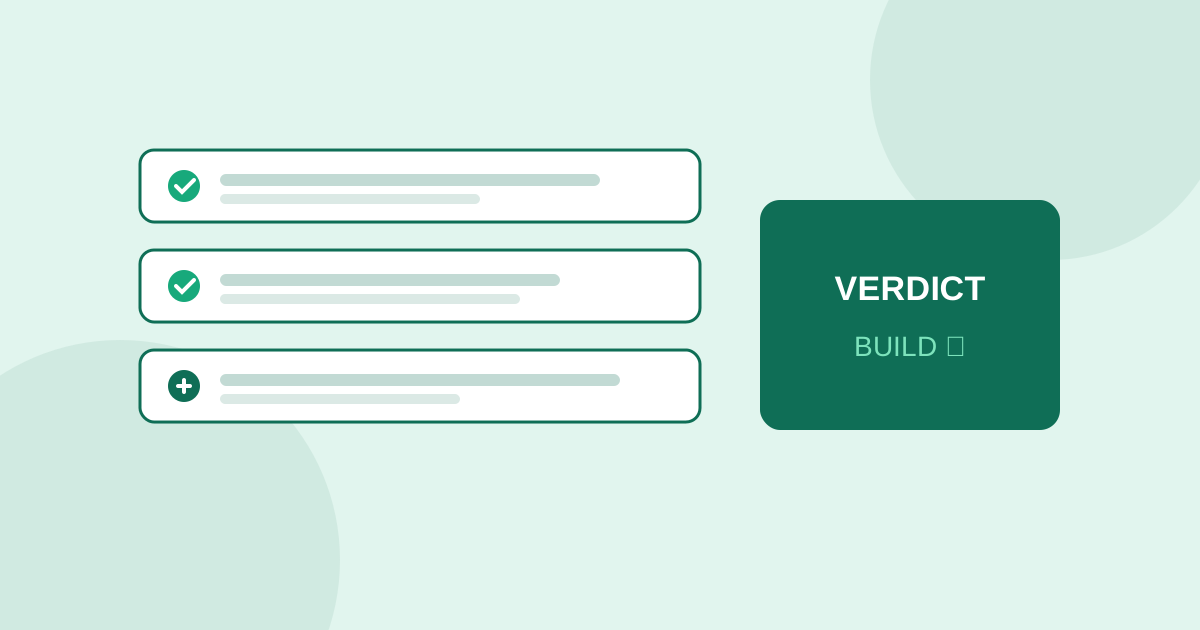
After 48 hours you should be able to answer four questions with evidence, not intuition. One: did the same pain appear on three or more independent sources? Two: do the quotes contain money or time language, not just mild annoyance? Three: can you name the incumbent that users are actively trying to escape? Four: can you write the one-sentence value proposition without hedging?
Four yes answers: build a prototype and start conversations, arriving with quotes instead of hypotheses. Three: build, but sharpen the weak dimension first. Two or fewer: skip, and be grateful you found out in a weekend instead of a quarter. Most ideas should die at this stage. That is the point. Validation is a filter, not a ceremony.
A worked example: freelancer invoicing
Public threads complain about chasing late payments, awkward reminder emails, tax confusion, and tools built for teams of ten when the user is a team of one. Cross-source checking shows the same frustration in Reddit freelance communities, in reviews of existing invoicing apps, and under YouTube videos about freelance finances. Intensity language is everywhere: shame about sending reminders, spreadsheets breaking at month end, clients ghosting after delivery.
Competition includes giants, yet users still express unmet needs around tone, automation and solo workflows. That combination, high validated pain plus incumbents that structurally ignore the segment, is exactly what a strong verdict looks like: proof of problem density, not yet proof of revenue, but more than enough to justify a two-week prototype and ten conversations that now start from evidence.
Validating in non-English markets
One blind spot deserves its own mention. Almost all validation tooling, and almost all validation advice, assumes English-speaking markets. If your idea targets French, Dutch, German, Spanish or other markets, the complaints exist just the same, but English-only tools cannot see them. That is either a research problem or an opportunity: markets that are harder to research are also less picked-over. UserConcern runs searches in 9 languages across 16 regions precisely because the loudest gaps are often outside the English internet.
After validation: your first week
A passing verdict earns the idea a week, not a company. Spend it like this. Days one and two: build the thinnest possible prototype or a concrete mockup of the core workflow. Days three to five: contact ten people who match the complaints you found, quoting their world back to them; response rates triple when outreach opens with their own problem in their own words. Days six and seven: decide again, this time with human reactions layered on top of the public evidence.
Forty-eight hours is enough to reject bad ideas and prioritize good ones when you stop guessing and start reading the market's own words. Compress weeks of manual scrolling into one evidence-backed view, then talk to humans to confirm, arriving with quotes, scores, and a hypothesis sharp enough that conversations move fast. Validation is not about permission to build. It is about refusing to spend months on a problem nobody described.
Frequently asked questions
How long does it take to validate a SaaS idea?
A first evidence-based verdict takes about 48 hours using public complaint data from sources like Reddit, Amazon reviews and YouTube. Full validation, including conversations with real prospects and a prototype test, typically takes two to three weeks. The 48-hour filter exists to make sure only ideas with proven problem density earn those weeks.
Can I validate a SaaS idea without customer interviews?
You can reach a reliable build-or-skip verdict without interviews by cross-checking complaints across at least three independent sources. Interviews remain valuable afterwards, but they work far better when you arrive with real quotes and a sharp hypothesis instead of open-ended questions.
What is the strongest signal that a SaaS idea is worth building?
The same specific pain appearing independently on three or more platforms, described with money or time language (losing clients, wasted hours, cannot trust), by people who are actively trying to escape a named incumbent tool. That combination of validated pain plus structurally ignored segment is the best pre-revenue signal available.
How do I validate an idea for a non-English market?
The complaints exist in every language, but most research tools only read English. Search local communities and marketplaces in the target language, or use a multilingual tool: UserConcern analyzes sources in 9 languages across 16 regions, which makes it possible to validate French, Dutch, German or Spanish-speaking markets that English-only tools cannot see.
What tools can I use to validate a SaaS idea?
You can do it manually with Reddit search, Amazon review filtering and YouTube comments, which costs hours per niche. UserConcern automates the same process: one search cross-checks 8 sources in about 60 seconds and returns ranked pain points with real quotes, opportunity scores and a build-or-skip verdict. The free plan includes one full search per month with no credit card.
More articles
 SaaS & Tech
How to Validate a Personal Finance App Idea Before You Write Code
Personal finance apps carry trust and regulatory weight that most SaaS ideas don't. Here's how to validate the pain point, the trust gap and the willingness to switch before you build a budgeting, saving or investing app.
Read article → SaaS & Tech
How to Validate a Mobile App Idea Before You Build It
Mobile apps face a harsher validation bar than web software: a crowded store, a permanent star rating and a platform fee before you ever prove value. Here is how to test demand for an app idea using real complaints before you write a line of Swift or Kotlin.
Read article →