
How to Validate a Personal Finance App Idea Before You Write Code
August 3, 2026 · 9 min read
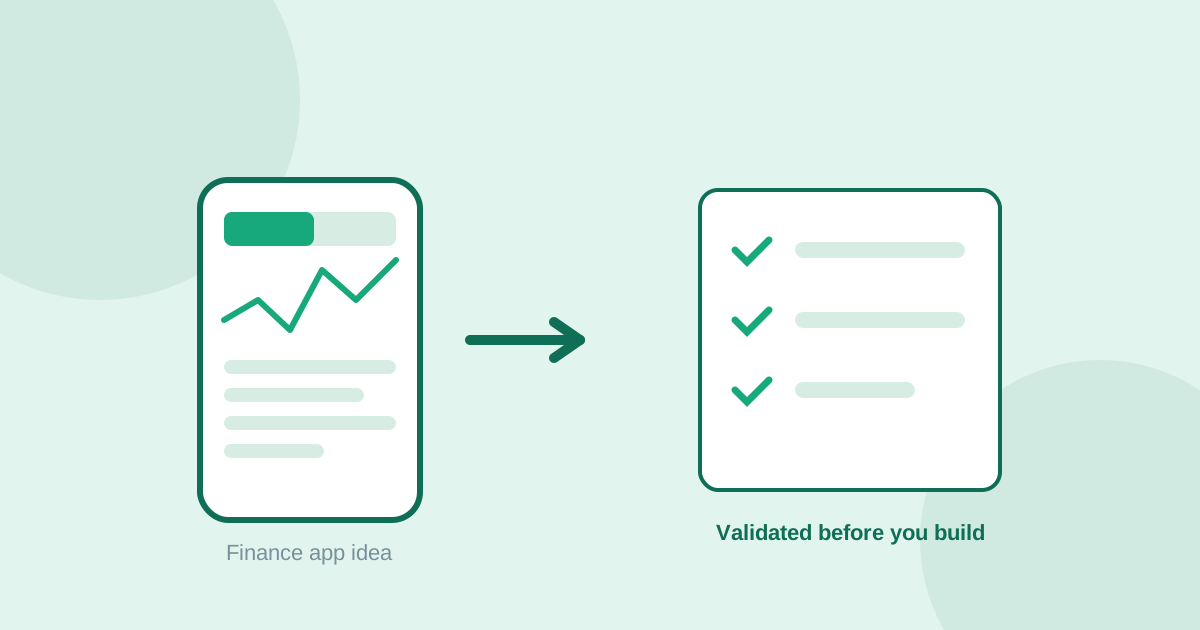
Personal finance apps fail for reasons that have almost nothing to do with code quality. The market is not short on budgeting apps, banking dashboards or investing trackers; a new search for any of those categories returns dozens of established options with millions of downloads. What kills most new entrants is a narrower, harder problem: getting someone to trust a new app with their bank connection, their spending history and their sense of financial control, for a benefit that feels worth the switch.
That trust requirement changes what validation needs to prove. A productivity app only has to be more useful than a spreadsheet. A finance app has to be more useful than a spreadsheet and trustworthy enough to link a checking account to, and those are separate hurdles that separate research methods have to test for. This guide walks through how to find that evidence in public complaints before you write a line of code, connect a banking API, or commit to the compliance overhead the category carries.
Why finance apps carry more validation risk than most SaaS ideas
Most SaaS ideas fail from indifference: nobody cares enough to switch. Finance apps can fail from the opposite problem: people care intensely, which means they arrive with high expectations, low tolerance for bugs near their money, and existing scar tissue from a previous app that lost their trust. A budgeting app that miscategorizes one transaction, or a saving app that shows a wrong balance for even a day, loses users permanently in a way a task manager with a similar bug would not. Validating a finance app idea means testing not just whether the underlying pain is real, but whether your specific approach clears a trust bar the category enforces unusually strictly.
There is also a compliance and integration cost that most SaaS categories do not carry: bank-linking infrastructure, data security expectations, and in some cases regulatory scope depending on what the app actually does with a user's money. That cost makes it more expensive than average to discover, after building, that the trust gap you assumed you could close was actually unclosable for reasons unrelated to your product's features. Reading complaints before you build is how you find that out cheaply instead of expensively.
A concrete example: the Mint shutdown created a real, verifiable gap
Intuit shut down Mint, long the most widely used free budgeting app in the U.S., in early 2024, migrating its users toward Credit Karma. That event is a useful, verifiable example of how a real gap gets created and how you would validate whether it is still open. In the aftermath, public discussion across personal finance communities repeatedly named specific reasons people did not want to move to the suggested replacement: a shift in focus from budgeting toward credit-monitoring and product recommendations, a different core workflow than the one users had built years of habit around, and a general wariness about where their financial data would be used next.
That kind of migration event is exactly the pattern worth searching for in any finance sub-niche you consider: a large incumbent changing direction, shutting down, or introducing a change users are vocal about resenting, followed by public discussion of what they actually want in a replacement rather than what they were offered. The specific requests in that discussion, not just the fact that people were unhappy, are the product brief.
Where to find the complaints
Personal finance communities on Reddit are unusually detailed and unusually honest, in part because financial stress motivates precise complaints: threads dedicated to budgeting, saving, debt payoff and specific life stages (new parents, first-generation earners, freelancers with irregular income) surface exactly which existing tools fail and how. App store reviews for the incumbents in your specific sub-niche, read at three stars rather than one, reveal the features that almost worked: a synced balance that lagged by a day, a categorization rule that could not be customized, a support team that took a week to respond to a locked-account issue. YouTube channels covering personal finance and budgeting methods have comment sections full of viewers comparing tools mid-video, often naming a specific frustration the video itself does not address. Quora questions about which budgeting or investing app to use surface the exact trust objections people raise before they will even try a new one.
Cross-checking matters more here than in most categories, precisely because of the trust stakes. A complaint about one incumbent's specific bug is not evidence of a category-wide gap; the same complaint about, say, budget categories that never match real spending, appearing independently across Reddit threads, app store reviews of multiple competing apps, and YouTube comments, is evidence that the underlying workflow assumption is wrong across the category, not just broken in one app.
Turning complaints into product and trust decisions
Once you have real complaints, split them into two buckets, because finance apps are validated on both. Feature and workflow complaints (categorization that requires constant manual correction, irregular income that breaks every monthly budget template, shared-expense tracking for couples that always assumes one income stream) tell you what to build, and UserConcern's Competitor Analysis and Solution Canvas tools are built specifically for turning a cluster of complaints like these into a scoped feature set rather than a vague direction. Trust and switching-cost complaints (fear of a new app's data practices, reluctance to relink a bank account after a bad experience elsewhere, distrust of ad-supported free tiers) tell you what to address directly in your onboarding and marketing copy, often before a user ever opens the budgeting screen itself, because for this category the trust pitch has to be made before the feature pitch lands.
Before you write code
Validate demand with a waitlist and a specific, evidence-backed value proposition before touching a bank-linking API, since that integration is the most expensive and slowest piece of the build to reverse. Use a Mini Business Plan pass to pressure-test whether the trust and compliance overhead of your specific approach (does it read balances only, or move money; does it need a money-transmitter consideration) is proportional to the pain point you found, since two ideas that sound similar in a pitch can carry very different regulatory weight. And cross-check any pain point across at least three independent sources before committing, since a single loud Reddit thread about a gap left by an incumbent's shutdown or redesign is a hypothesis, and the same complaint confirmed independently in app store reviews and YouTube comments is a much stronger reason to start building.
Frequently asked questions
How is validating a personal finance app different from validating other SaaS ideas?
Most SaaS ideas fail from indifference, but finance apps have to clear a trust bar as well as a usefulness bar: users need to believe a new app is worth linking their bank account to. Validation has to test both the underlying pain point and the specific trust objections people raise before they will switch, using complaints that name both the feature gap and the trust concern separately.
Where do people complain about budgeting and finance apps?
Personal finance communities on Reddit, three-star app store reviews of existing budgeting and investing apps (which reveal near-misses rather than total failures), YouTube comment sections under personal finance and budgeting-method videos, and Quora questions comparing specific apps. Major migration events, like an incumbent shutting down or changing direction, are especially useful moments to search, since they surface exactly what users wanted from a replacement.
Is a large incumbent shutting down always a validated opportunity?
Not automatically. A shutdown creates displaced users, but you still need to confirm, across multiple independent sources, that a specific unmet need is driving their dissatisfaction with the suggested replacement, rather than general reluctance to switch tools at all. Reading what people say they actually want in a replacement, not just that they are unhappy, is what turns a migration event into a product brief.
What should I validate before connecting a bank-linking API?
Validate the underlying pain point and the specific trust objections your target users have, using public complaints and a waitlist with a concrete value proposition, before integrating bank-linking infrastructure. That integration, along with any related compliance and security overhead, is the most expensive and slowest part of the build to reverse, so it should be the last step, not the first.
More articles
 SaaS & Tech
How to Validate a SaaS Idea in 48 Hours (With Evidence, Not Opinions)
A step-by-step framework to validate a SaaS idea in one weekend using real customer complaints from 8 sources, with a worked example and a clear build-or-skip verdict.
Read article → SaaS & Tech
How to Validate a Mobile App Idea Before You Build It
Mobile apps face a harsher validation bar than web software: a crowded store, a permanent star rating and a platform fee before you ever prove value. Here is how to test demand for an app idea using real complaints before you write a line of Swift or Kotlin.
Read article →