
How to Validate a Business Idea for Free (Before Spending a Cent)
July 12, 2026 · 8 min read
Most business ideas die from one of two causes: building something nobody wanted, or never starting because validation seemed to require money the founder did not have. Both deaths are avoidable. Real demand leaves public traces, and reading those traces costs nothing but attention.
This guide is a zero-budget validation process that works for SaaS, e-commerce products, services and content businesses. No ad spend, no agencies, no paid panels. Just evidence, gathered in the right order.
The principle: demand leaves traces
Before anyone buys a product, they complain about the problem it solves. They complain on Reddit, in reviews of inferior products, in YouTube comments, in Quora questions, in Facebook groups. They search Google for workarounds. They ask AI assistants for recommendations. Every one of those actions is free to observe. Validation is the discipline of reading these traces before writing code or ordering inventory, and being willing to hear no.
Stage 1: the complaint scan (cost: 0, time: one evening)
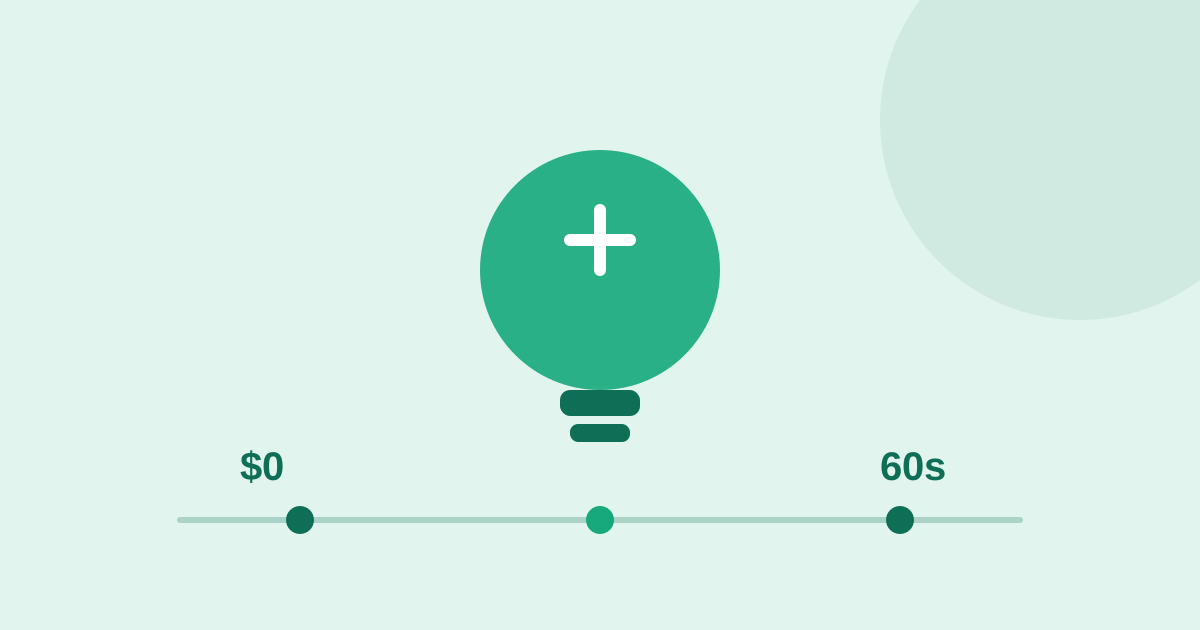
Search your niche plus pain language across public platforms: I wish, is there a, why is it so hard, sick of. Read one-star and three-star reviews of the closest existing products. Scan YouTube comments under tutorials in your space; comment sections under how-to videos are wish lists in disguise. Collect verbatim quotes with links. You are looking for the same frustration repeated by different people in different places. If you prefer speed over manual work, UserConcern's free plan runs this entire scan across 8 sources in about 60 seconds, one search per month, no credit card.
Stage 2: the competition reality check (cost: 0, time: two hours)
List everything people currently use for this problem, including non-obvious competitors like spreadsheets, notebooks, hired help or simply enduring it. For each, read what users say when it fails them. Competition is not a bad sign; it proves budget exists. The question is whether the complaints reveal a segment or workflow the incumbents structurally ignore. No competition plus no complaints is the real danger signal: it usually means no market.
Stage 3: the language test (cost: 0, time: one hour)
Write one sentence: [person] struggles with [specific pain] because [current options fail in a specific way]; my idea fixes it by [mechanism]. Every element must come from quotes you actually collected, not from your imagination. If you cannot fill the template with evidence, return to stage one or drop the idea. This sentence becomes your landing page headline, your outreach opener and your elevator pitch, which is why it must be built from the market's words rather than yours.
Stage 4: the conversation test (cost: 0, time: one week)
Find ten people who match the complaints you collected: the same communities you researched are full of them. Message them referencing their world specifically, ask about the last time the problem occurred, and listen for what they already tried and what it cost them. Do not pitch. If several independently describe the pain the way your quotes did, and light up when you describe the mechanism, you have converging evidence. If they shrug, believe the shrug.
Stage 5: the smallest possible promise (cost: 0 to almost 0)
Only now build something: a one-page description of the offer with a way to say yes. A free landing page with a waitlist, a Google Form pre-order, a concierge version of the service delivered manually to two clients. The goal is one real commitment signal: an email address given eagerly, a deposit, a scheduled call. One stranger who commits is worth a hundred friends who encourage.
What free validation cannot tell you
Honesty matters here. Zero-budget validation proves problem density: the pain is real, frequent and badly served. It does not prove price tolerance, channel economics or retention. Those answers cost a small prototype and real usage. But the sequence matters: proving the problem for free before spending anything on the solution is how you make sure the money you eventually spend lands on something people already asked for.
Frequently asked questions
Can I really validate a business idea with no money?
Yes, for the most important question: does the problem exist and hurt enough. Public complaints, competitor reviews, community conversations and direct outreach cost nothing and reveal problem density. Later stages, like testing price and retention, require a small prototype, but by then you are spending on evidence instead of hope.
How long does free validation take?
One evening for the complaint scan, two hours for competition analysis, one hour for the language test, and about a week for ten real conversations. Roughly ten days from idea to an evidence-based decision, or faster if you automate the complaint scan with a tool like UserConcern, whose free plan covers 8 sources in one search.
What is the biggest mistake in idea validation?
Asking people if they would use your product. Hypothetical questions produce polite lies. Validation should rest on what people already do and say: unprompted complaints, failed workarounds, past purchases and real commitment signals like waitlist signups or deposits.
Does this process work for e-commerce and services, not just SaaS?
Yes. The traces differ slightly (product reviews matter more for e-commerce, local community groups for services) but the sequence is identical: find repeated complaints, map failed alternatives, write the value sentence from real quotes, talk to ten matching people, then collect one real commitment before building.
More articles
 SaaS & Tech
How to Validate a SaaS Idea in 48 Hours (With Evidence, Not Opinions)
A step-by-step framework to validate a SaaS idea in one weekend using real customer complaints from 8 sources, with a worked example and a clear build-or-skip verdict.
Read article →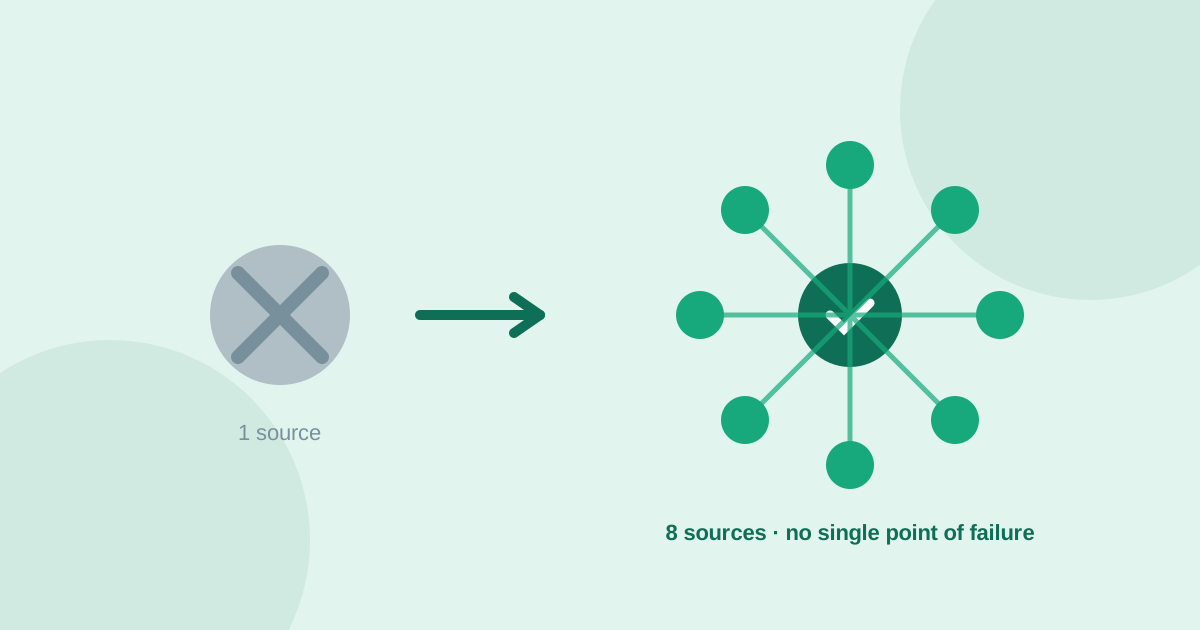 Market Research
Best GummySearch Alternatives in 2026 (Access Ends 30 November)
GummySearch closed to new customers in November 2025, and existing users lose access on 30 November 2026 with all data deleted the next day. Eight alternatives compared on real pricing, real sources, and which half of the job each one actually replaces.
Read article →