
Best Syften Alternatives in 2026 (Keyword Alerts vs. Cross-Source Validation)
November 10, 2026 · 9 min read
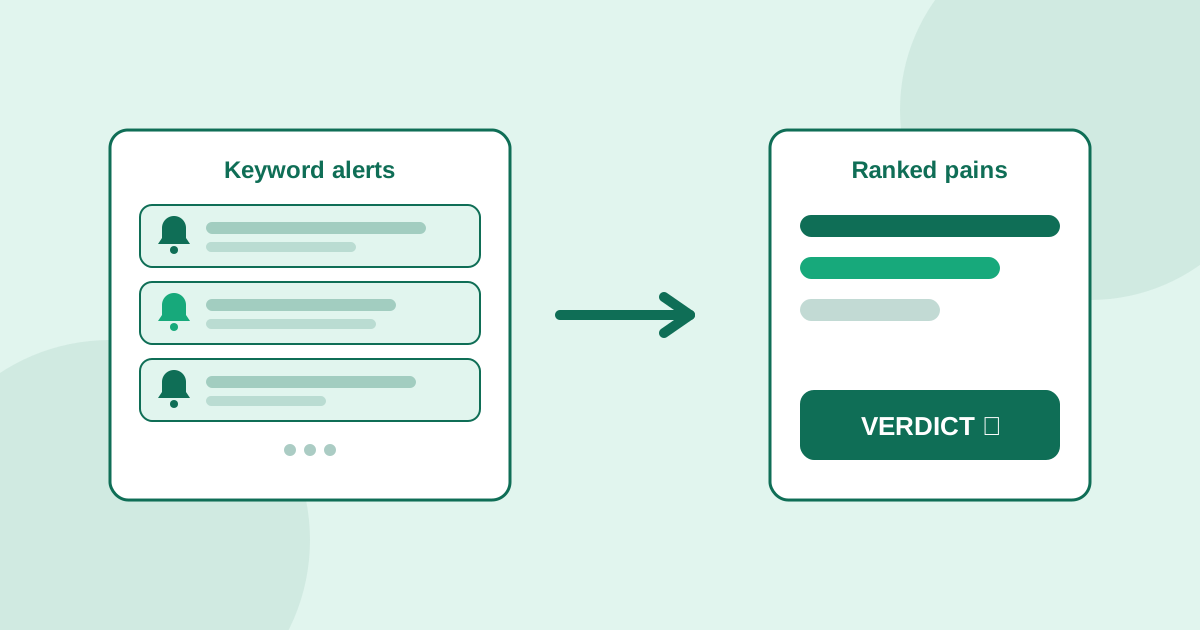
Syften is one of the more established names in community keyword monitoring, and people search for alternatives to it for two different reasons. Some want another alert tool, usually because of price, filter limits or a source they need that is not in their plan. Others set it up at the idea stage, hoping a steady stream of matching posts would tell them whether a market was worth entering, and ended up with a busy inbox and no clearer answer. This article is mostly for the second group. It tries to be fair to Syften throughout, because for the job it was built for it is a good product.
What Syften actually does
Syften is a keyword monitoring service for online communities. You write filters, and when a new post or comment matches one of them, Syften notifies you. According to its own pricing page, the community sources include Reddit, forums, Stack Exchange, Hacker News and GitHub, with separate web filters covering the public web. X and YouTube monitoring are sold as paid add-ons on the higher plans, and the Standard plan adds a Slack integration.
At the time of writing, its pricing page lists three self-serve plans billed monthly. Entry is $29.95 a month for 3 community filters and 1 web filter. Standard is $49.95 a month for 20 community filters and 5 web filters. Syften PRO is $119.95 a month for 100 community filters and 20 web filters, and adds webhooks, an MCP integration and full archive history. There is also a tailor-made option without a listed price, and a 14-day free trial with no credit card required. Plans and limits change, so check the page yourself before you buy.
What it does well
Speed and coverage are the point. If someone on Hacker News asks for a tool like yours, or a Reddit thread starts comparing your product with a competitor, the value of knowing within minutes rather than next week is obvious. A well-tuned alert feed turns those moments into replies, support saves and sales conversations that would otherwise have happened without you.
The filters are the other strength. Community monitoring lives or dies on noise, because a plain keyword match on a common word floods you with irrelevant posts. Tools in this category that let you combine terms, exclude phrases and restrict matches to particular communities make the difference between a feed you read and a feed you mute. Syften has a long-standing reputation among indie founders for exactly that kind of precise filtering, and the developer-heavy sources it covers, Stack Exchange, GitHub and Hacker News, are ones that many social listening tools ignore.
If your job is brand monitoring, competitor mention tracking, community-led support or finding live threads where a helpful reply could bring in a customer, keyword alerts are the right category, and replacing them with a validation tool would be a mistake.
Where keyword alerts stop being validation
The limit is not a missing feature. Alerting and validation answer different questions, and an excellent answer to the first tells you surprisingly little about the second.
First, alerts only find what you already thought to ask about. A filter is a guess written down in advance. If the real problem in a market is described in words you did not anticipate, the alert never fires, and silence looks like a lack of demand when it is really a lack of the right keyword.
Second, a feed is a stream, not a ranking. Fifty matching posts a week tells you a topic is discussed. It does not tell you which complaint comes up most often, which is the most painful, or which one people are already paying to work around. Turning a stream of mentions into a ranked list of problems is manual work, and it is the part of validation that actually decides the build.
Third, alerts look forward from the day you set them up. An idea-stage decision needs the history: what people have been complaining about over the past year, not just what they happen to post this week. A new filter mostly looks forward. Syften's plans do include some archive search, 7 days on Entry, 30 days on Standard and full available history on PRO, but that is still a keyword search rather than an analysis.
Fourth, community sources share a bias. Reddit, Hacker News, Stack Exchange and GitHub are full of people who enjoy discussing tools, and they skew technical. Plenty of real markets barely show up there: the buyers write Amazon reviews, comment under YouTube videos, ask questions on Quora or simply search Google. A pain point that only exists inside developer communities may be real, but it is not yet proven to be a market.
The alternatives, by the job you actually have
If the job is real-time mention monitoring, stay in the keyword alert category. Tools in it differ mainly in which sources they cover, how precise the filters are, how fast alerts arrive and how much they cost per filter, so compare them on those details. F5Bot is a free option for basic Reddit and Hacker News alerts; paid tools add more sources, better filtering and team features.
If the job is broad brand reputation tracking across news, review sites and mainstream social networks, a social listening platform fits better than a community-focused alert tool. Those are built for marketing and PR teams and are priced accordingly.
If the job is spotting topics that are rising before they peak, you want a trend-discovery tool, which looks at the direction of search and social interest over time rather than individual posts.
If the job is deciding whether an idea is worth building, you need ranked, cross-checked problems with evidence, not a feed. You can do that by hand: search each relevant subreddit sorted by top for the past year, read the two- and three-star Amazon reviews on the leading products, read the comments under the most-watched YouTube videos on the topic, and tally which complaints repeat across all three. It works, and it takes most of a weekend per idea.
Where UserConcern fits
UserConcern automates that last job. One search cross-checks 8 sources, Reddit, Amazon reviews, YouTube, TikTok, Quora, X/Twitter, Google Trends and AI answers, in about 60 seconds, and returns ranked pain points with the original quotes linked back to where they were posted, an opportunity score and a build-or-skip verdict, in 9 languages. You describe the idea or the market in plain words rather than writing a filter, and the search looks backward across what people have already said instead of waiting for new posts.
From there, Competitor Analysis and Review Intelligence show what users praise and criticise about the products already in the space, and the Solution Canvas and Mini Business Plan turn a surviving pain point into a one-page draft you can test with real people.
It is worth being equally clear about what it does not do. UserConcern does not send you a notification when someone mentions your brand on Hacker News tomorrow, it does not post into Slack every time a competitor is named, and it does not monitor GitHub issues or Stack Exchange as a live feed. If catching conversations as they happen is the job, it is not a substitute for an alert tool.
Using both together
The two kinds of tool are sequential, and the strongest workflow uses both in a specific order. Start with cross-source validation to decide whether there is a problem worth solving at all. Most ideas will not survive that step, which is the point. For the ones that do, you come away with the problem described in the customer's own words, the products currently failing them and the exact phrases they use.
Those phrases are what make alert filters good. Instead of guessing keywords, you write filters around the language people actually used in the complaints you just found, the product names they mentioned and the workarounds they described. The alert tool then does what it does best: it puts you in front of the next person who describes that problem, at the moment they describe it, which is the best possible moment to talk to a future customer.
Used the other way around, the combination is weaker. Setting up alerts first and waiting to see what comes in is a slow, keyword-shaped way to discover a market, and a quiet inbox after a month proves very little. Validate first, then listen.
Frequently asked questions
Is Syften good for validating a business idea?
It is useful for listening once you know what to listen for, and weak as a validation test on its own. Alerts only match the keywords you choose in advance, arrive as an unranked stream starting from the day you set them up, and come mostly from community sources such as Reddit, Hacker News, forums, Stack Exchange and GitHub. A build decision needs ranked, historical problems confirmed across several independent sources.
What is the difference between Syften and UserConcern?
Syften is a keyword monitoring service that notifies you when new posts on Reddit, forums, Stack Exchange, Hacker News, GitHub and the web match your filters, with X and YouTube available as add-ons on higher plans. UserConcern runs a one-off search across 8 sources (Reddit, Amazon reviews, YouTube, TikTok, Quora, X/Twitter, Google Trends and AI answers) and returns ranked pain points with source quotes, an opportunity score and a build-or-skip verdict. One tells you when a conversation happens, the other tells you which problem is worth building for.
How much does Syften cost?
At the time of writing, Syften's pricing page lists Entry at $29.95 a month, Standard at $49.95 a month and Syften PRO at $119.95 a month, plus a tailor-made option, with a 14-day free trial and no credit card required. X and YouTube monitoring are listed as paid add-ons. Check the official page for current pricing, since plans change.
Can I use a keyword alert tool and a validation tool together?
Yes, and the order matters. Validate first to confirm there is a real, repeated, costly problem and to learn the exact words people use for it. Then build alert filters around those words so you are notified the next time someone describes the problem, which is the ideal moment to start a conversation.
Is there a free alternative to Syften?
For basic Reddit and Hacker News keyword alerts, F5Bot is a widely used free option, with fewer sources and less filtering control. For idea validation rather than alerting, UserConcern has a free search that cross-checks 8 sources and returns ranked pain points.
More articles
 Market Research
Best GummySearch Alternatives in 2026 (Access Ends 30 November)
GummySearch closed to new customers in November 2025, and existing users lose access on 30 November 2026 with all data deleted the next day. Eight alternatives compared on real pricing, real sources, and which half of the job each one actually replaces.
Read article → Market Research
How to Identify Customer Pain Points: 7 Methods That Actually Work
Customer pain points are the raw material of every successful product. Here are 7 practical methods to find them, from free manual research to AI-powered analysis.
Read article →