
How to Mine Quora for Real Customer Pain Points (Step-by-Step Guide)
August 3, 2026 · 7 min read

Quora looks quieter than Reddit, and that is exactly why most founders skip it. There is no upvote storm, no viral thread, no obvious sign that a question matters. What Quora has instead is specificity: people arrive there already mid-research, typing a precise version of their problem into a question box because a general search engine did not resolve it. That specificity makes Quora one of the highest-intent sources for pain point research, even though it is one of the least visited by founders doing that research.
This guide gives you a repeatable method for mining Quora: how to find the questions that matter, how to read answers for what they are missing rather than what they say, how to collect the language buyers actually use, and the one trap that makes Quora research misleading if you skip it.
Step 1: find the questions your audience is actually asking
Start by searching your niche as a question, not a keyword. Quora rewards phrasing that matches how people naturally ask for help: what is the best way to, why does X always, how do I fix, is it normal for. Look at the follower count and view count on each question, both are visible on Quora and both indicate how many people share the same unresolved question, even if they never wrote an answer themselves. A question with thousands of followers and only a handful of thin answers is a stronger signal than a question with one detailed, well-upvoted answer that already fully resolved the topic.
Step 2: search with problem language, not product language
The same rule that works on Reddit works on Quora: search for the words people use when something is going wrong, not the name of a product category. Patterns worth trying: what's the alternative to, why is X so expensive, how do I avoid, what do people use instead of, is there a better way to. Product-name searches surface recommendation threads. Problem-language searches surface the frustration those recommendations were trying to fix in the first place.
Step 3: read answers for what is missing, not just what is said
Quora's format makes gaps unusually visible. Scroll to the bottom of a heavily followed question and look at how thin, generic or outdated the top answers are relative to the follower count. A question with 4,000 followers and answers that only restate the obvious, or that were written years ago and never updated, is telling you the demand for a good answer still exists and has not been satisfied. That gap between follower count and answer quality is a more reliable pain signal on Quora than the answers themselves.
Step 4: collect quotes and follow-up comments verbatim
The comments underneath answers are often more useful than the answers. People reply to a partial answer with this didn't work for me, what about when, or has anyone tried this for a different situation, which is a direct, unprompted statement of what the existing answer failed to cover. Copy these exactly, with a link back to the thread. They become evidence for whether a pain point is real, raw material for content or product copy that speaks the audience's own language, and a source of outreach angles if you plan to talk to people who asked or engaged with the question.
Step 5: check whether the same names keep answering
Notice when a small number of prolific answerers dominate a topic on Quora, which happens often in professional and B2B niches. Their answers tend to be well-written and confident, which can make a niche look better served than it actually is. Read those confident answers skeptically: are they addressing the specific edge case the question asked, or giving generic advice that happens to rank well because the same person answers hundreds of similar questions. A confident, popular answer that dodges the actual specifics of the question is itself a sign of unmet demand, not evidence the topic is already solved.
The trap: Quora rewards popularity, not resolution
Quora's own ranking surfaces answers by engagement, not by whether they actually solved the asker's problem. An answer can accumulate upvotes for being well-written, funny or confidently stated while never addressing the specific frustration in the question. That means a highly-upvoted top answer is not proof the pain point is already served, it is only proof that people liked reading it. Before concluding a Quora topic is saturated, check whether the top answer actually resolves the specific version of the problem being asked, or whether it is a popular answer to a slightly different, easier question.
Putting it together
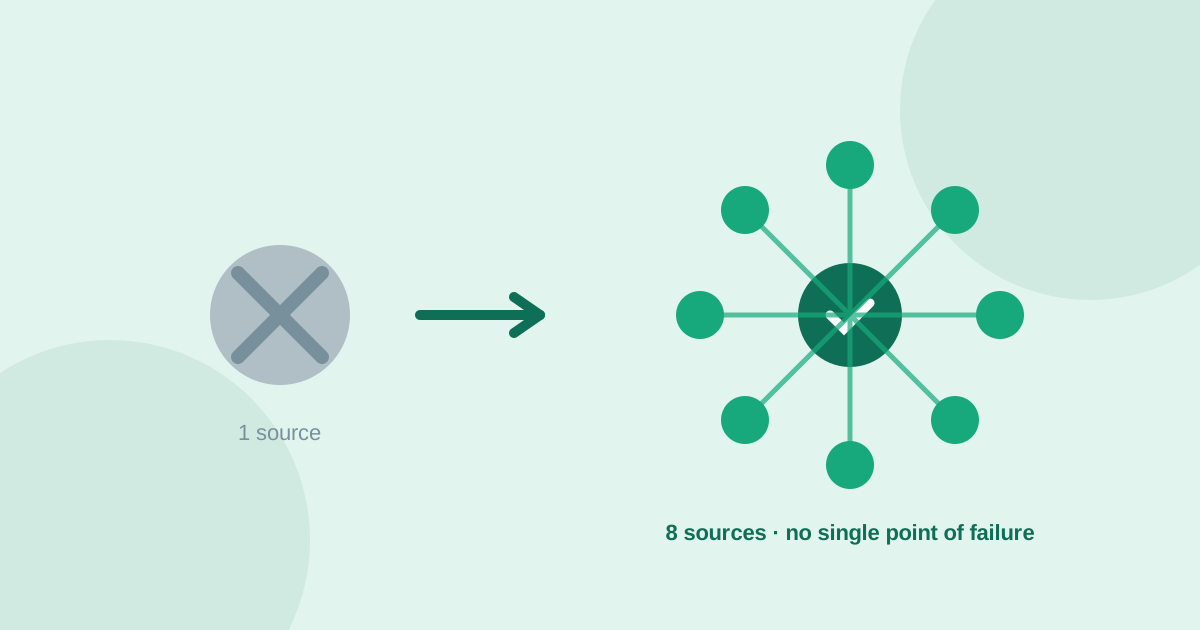
Quora's real strength is intent, not volume: the people asking these questions are already searching for a solution, which puts them further down the decision path than someone posting a general complaint on Reddit. But Quora alone has the same blind spot every single-source method has. A gap that looks wide open on Quora might already be filled by a product or community that simply is not active on Quora. Before acting on a Quora-only finding, check whether the same frustration shows up independently on Reddit, in Amazon reviews or in YouTube comments. UserConcern runs that cross-check automatically, scanning Quora alongside Reddit, Amazon reviews, YouTube, TikTok, X, Google Trends and AI answers in one search, so a high-intent Quora question only counts as validated demand once it is confirmed outside Quora too.
Frequently asked questions
Is Quora good for finding customer pain points?
Yes, particularly for high-intent research. People who post questions on Quora are already mid-research on a specific problem, which makes their language more precise than a general complaint. The catch is that answer popularity does not equal resolution, so check whether top answers actually address the specific question before assuming the gap is filled.
What should I search for on Quora to find pain points?
Search problem language rather than product names: phrases like what's the alternative to, why is X so expensive, how do I avoid, and what do people use instead of, combined with your niche terms. These patterns surface unresolved frustration instead of generic recommendation threads.
How do I know if a Quora topic is already well served?
Compare the follower count on a question to the quality and freshness of its top answers. A question with thousands of followers and only thin, outdated or generic answers means demand still exists and has not been satisfied, regardless of how many upvotes those answers have.
How do I confirm a Quora pain point is a real market?
Cross-check it against at least two or three independent sources, such as Reddit, Amazon reviews or YouTube comments. Quora shows high-intent demand, but it cannot tell you whether the gap is already filled by a solution that simply is not active on Quora. UserConcern automates this check across 8 sources, including Quora, in one search.
More articles
 Market Research
Best GummySearch Alternatives in 2026 (Access Ends 30 November)
GummySearch closed to new customers in November 2025, and existing users lose access on 30 November 2026 with all data deleted the next day. Eight alternatives compared on real pricing, real sources, and which half of the job each one actually replaces.
Read article → Market Research
How to Identify Customer Pain Points: 7 Methods That Actually Work
Customer pain points are the raw material of every successful product. Here are 7 practical methods to find them, from free manual research to AI-powered analysis.
Read article →