
Best PainPointMap Alternatives in 2026 (Reddit-Only Scanning vs. Cross-Source Validation)
August 21, 2026 · 8 min read
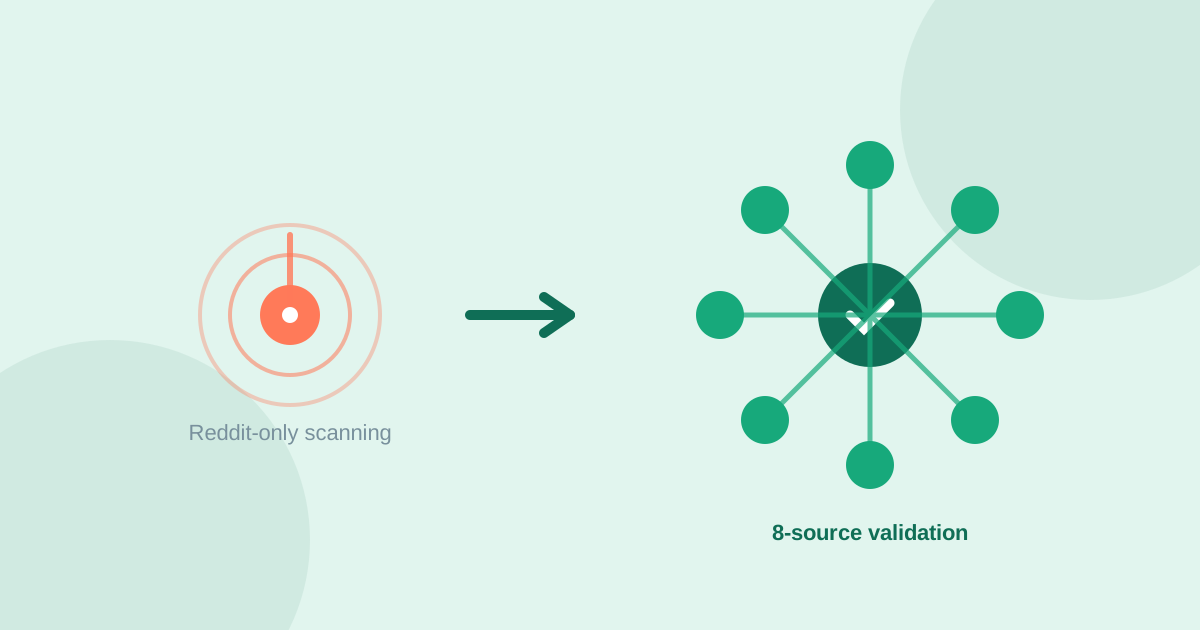
PainPointMap's pitch is direct: point it at a niche, let its AI scan Reddit communities, and get back a ranked list of pain points scored by severity and frequency, complete with real quotes and permalinks so you can verify every finding yourself. It is one of a wave of Reddit-focused research tools that appeared after GummySearch's shutdown left a gap in the market, and its severity-scoring and competitor-mapping features put it a step ahead of the simplest keyword-alert tools in that wave.
This guide covers what PainPointMap actually does, what its subscription tiers include, where a Reddit-only scanning tool is genuinely the right choice, and where the same design runs into the structural limit every single-platform research tool eventually hits.
What PainPointMap actually does
PainPointMap's core workflow is a scan: you point it at a niche or set of subreddits, and its AI reads through the community's posts, deduplicates repeated complaints, and returns each distinct pain point with an AI-scored severity and frequency rating, a real quote, and a permalink back to the original Reddit thread so the finding is checkable rather than a black box. On the Professional tier, a scan also produces a competitor map with gap analysis, showing which existing products or services are already mentioned as attempted solutions and where users say those solutions still fall short.
Each pain point comes bundled with AI-generated solution ideas, three per finding on the Starter plan, up to ten on Professional, plus a "copy as prompt" export that formats the finding for pasting straight into ChatGPT or Claude for further brainstorming. Professional subscribers also get PDF startup-idea reports for sharing findings outside the tool, and access to "Pain Atlas," a library of pre-scanned niches you can browse without running your own scan. Pricing is subscription-based: Starter runs $19 a month for 10 scans a day across 2 subreddits per scan, and Professional runs $49 a month for 15 scans a day across 5 subreddits per scan, with competitor mapping and gap analysis unlocked. Both tiers include a 7-day free trial.
Where it's genuinely useful
For anyone whose research question begins and ends with Reddit, PainPointMap is a well-built tool. The severity-and-frequency scoring is a real step up from simply reading a wall of threads in the order Reddit's search returns them, and the permalink-backed quotes mean you are never asked to trust an AI summary without a way to check the source yourself, which is the right design choice for any tool making pain-point claims. The competitor-mapping and gap-analysis feature on the Professional tier is a genuine differentiator inside the Reddit-only category: most competing Reddit tools stop at listing complaints and leave you to separately research who already serves that need, while PainPointMap tries to answer both in one scan. The Pain Atlas library is a reasonable way to browse pre-scanned niches for inspiration without spending a scan credit, and the "copy as prompt" export is a small but genuinely useful touch for anyone whose next step is feeding findings into an LLM for further idea generation.
Where a Reddit-only tool hits a ceiling
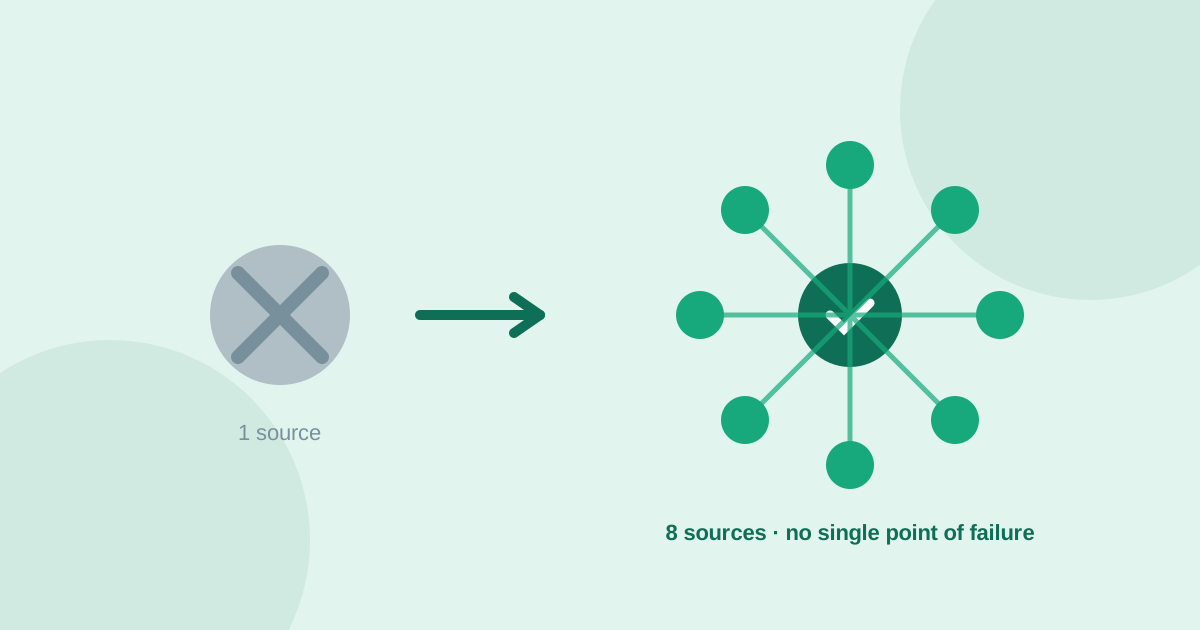
The limitation is the one every Reddit-only research tool shares, regardless of how good its scoring model is: Reddit is a single platform with a specific demographic skew, a specific culture, and a specific set of communities that self-select for a particular kind of user. A pain point that scores high severity inside a PainPointMap scan can be a real, widespread market gap, or it can be an artifact of what one particular subreddit's most vocal members happen to complain about. The tool has no way to distinguish the two, because severity and frequency are both measured entirely inside the same single data source. This is the exact structural weakness that made GummySearch's whole business vulnerable to one Reddit API pricing decision: when the product's evidence and the product's risk both live on one platform, a scan can look thorough while still resting on one community's obsession rather than a confirmed market pattern.
The same question comes up for anyone leaving GummySearch. Eight alternatives, compared on real pricing, sorts them by whether you need monitoring or research.
There is a second, more practical constraint worth naming plainly: subreddit and scan limits scale with price. The Starter plan's 2-subreddits-per-scan cap means a founder researching a niche that spans several loosely related communities will either run multiple scans or miss threads sitting just outside the chosen subreddits, and the competitor-mapping feature that would help resolve exactly that kind of gap is reserved for the $49 tier.
What to use instead, depending on the job
If your job is scanning a niche's Reddit conversation quickly, getting a severity-ranked starting list of complaints, and browsing a library of pre-scanned ideas for inspiration, PainPointMap's scoring model and Pain Atlas make it a sensible, purpose-built choice for exactly that. If your job is deciding whether a pain point is real enough, and big enough, to justify weeks of building before you commit to it, a severity score computed entirely from Reddit is a single data point, not a verdict, and treating it as one is how founders end up building for a subreddit instead of a market.
Where UserConcern fits
UserConcern is built for that second job. One search cross-checks 8 sources, including Reddit, Amazon reviews, YouTube, TikTok, Twitter/X, Quora, Google Trends and AI answers, in about 60 seconds, across 9 languages and 16 regions, and returns ranked pain points with the original quotes linked back to their source, an opportunity score, and a build-or-skip verdict. Where PainPointMap's strength is a fast, well-scored read of what one platform's communities are saying, UserConcern's strength is confirming whether the same complaint survives independently outside Reddit, which is the check that actually separates a subreddit's pet peeve from a real, buildable market.
The honest way to choose: if you want a quick, well-organized first look at what a niche's Reddit communities are complaining about, or you want to browse pre-scanned ideas for inspiration, PainPointMap's Reddit-only scanning and Pain Atlas are well-matched to that job. If you are about to commit real weeks of building time to a pain point, cross-source validation is the step that has to happen before you trust a single platform's severity score, not instead of it. Many founders reasonably use both in sequence: a broad cross-source search to confirm the pain point is real outside Reddit, then a focused Reddit-only tool to go deep on community-specific language and objections once the opportunity itself is already confirmed.
Frequently asked questions
What is PainPointMap?
PainPointMap is an AI-powered Reddit scanning tool that identifies pain points inside a niche's subreddit communities, scores each one by severity and frequency, and links back to the original post so findings can be verified. Its Professional tier adds competitor mapping and gap analysis, showing which existing products are already mentioned and where users say they fall short.
How much does PainPointMap cost?
PainPointMap uses monthly subscription pricing: Starter is $19 a month for 10 scans a day across 2 subreddits per scan with up to 3 AI-generated solution ideas per pain point, and Professional is $49 a month for 15 scans a day across 5 subreddits per scan, up to 10 solution ideas, plus competitor mapping and gap analysis. Both tiers include a 7-day free trial.
Does PainPointMap analyze anything besides Reddit?
No. PainPointMap's data source is Reddit exclusively. That is a deliberate design choice, and its severity and frequency scoring is genuinely useful for reading Reddit communities quickly, but it means every finding is inherently a Reddit-only signal, with no way to confirm whether the same pain point holds up on Amazon, YouTube, TikTok or elsewhere.
What is the main difference between PainPointMap and UserConcern?
PainPointMap scans Reddit communities in a chosen niche and scores pain points by severity, frequency and (on its Professional tier) competitive gap, all measured within Reddit alone. UserConcern cross-checks 8 sources, including Reddit, Amazon reviews, YouTube, TikTok, Quora, X, Google Trends and AI answers, in 9 languages, so a pain point's score reflects whether it holds up across independent platforms, not just within one community.
Should I use a Reddit-only tool or a cross-source tool first?
Cross-source validation is the stronger first filter, because it tells you whether a pain point is a real market pattern or a single community's quirk before you invest more time. A Reddit-focused tool like PainPointMap is a strong second step once the opportunity is confirmed, for going deep on the specific language, objections and competitor gaps inside the Reddit conversation around it.
More articles
 Market Research
Best GummySearch Alternatives in 2026 (Access Ends 30 November)
GummySearch closed to new customers in November 2025, and existing users lose access on 30 November 2026 with all data deleted the next day. Eight alternatives compared on real pricing, real sources, and which half of the job each one actually replaces.
Read article → Market Research
How to Identify Customer Pain Points: 7 Methods That Actually Work
Customer pain points are the raw material of every successful product. Here are 7 practical methods to find them, from free manual research to AI-powered analysis.
Read article →