
What Home Improvement and DIY Shoppers Are Really Complaining About in 2026 (Review Mining Analysis)
September 28, 2026 · 8 min read

Home improvement looks like a fully solved category from the outside: two dominant big-box retailers, decades-old power tool brands, and a paint aisle that already offers thousands of colors. Reading the actual complaints tells a different story. Buyers aren't struggling to find products, they're struggling with the systems around those products, the battery ecosystem a tool purchase locks them into, the color that looked right on the swatch, the instructions that assume a step nobody explained.
We ran a UserConcern analysis across home improvement and DIY subreddits, Amazon and retailer reviews of power tools, paint and flat-pack furniture, and YouTube project and review comments, to see what buyers keep describing once a purchase turns into an actual weekend project. Five patterns stood out clearly enough to be worth sharing.
Pain point one: battery ecosystem lock-in that quietly taxes every future purchase
Cordless power tools are sold individually, but the real purchase decision is a platform: once you own one brand's battery, every future drill, saw or blower you buy is either that same brand or a second, incompatible battery to charge and store. Reviewers describe realizing this only after their second or third tool purchase, frustrated that a cheaper or better-reviewed tool from a competing brand is effectively off-limits unless they buy an entirely separate battery and charger. The complaint isn't about any single tool's quality, it's that the platform lock-in is rarely disclosed clearly at the point of the first purchase, and switching costs compound with every tool added to the collection.
Pain point two: paint color-match that doesn't survive the trip home
In-store color matching, whether from a swatch, a fabric sample or a photo on a phone, is one of the most consistently complained-about steps in the entire category. Reviewers describe a color that looked correct under store lighting turning out noticeably different on a wall under home lighting, and worse, a second gallon mixed weeks later for a touch-up not matching the first can at all. The pattern shows up across multiple retailers and multiple paint brands, which suggests the gap is in the matching and batch-consistency process itself, not any one company's formula.
Pain point three: assembly instructions that assume the step nobody explained
Flat-pack furniture and DIY shelving kits draw a specific, repeated complaint: the instructions are diagram-only, with no written explanation for the one step that actually causes confusion, which way a asymmetric bracket faces, how much force a snap-fit joint is supposed to take before something is wrong. Reviewers describe redoing a step twice, or giving up and searching YouTube for someone else's unboxing video to see the same moment demonstrated in real time, effectively outsourcing the manufacturer's own documentation to a stranger's video.
Pain point four: missing or mismatched hardware inside the box
A specific and recurring one and two star review pattern across furniture, shelving and hardware kits: a missing screw, a bag of the wrong bolts, or a part labeled inconsistently between the box and the instruction sheet. The complaint is rarely about the product's design, it's about what happens next, most retailers have no simple way to request just the one missing part, forcing the buyer to either return an otherwise-fine item or drive to a hardware store to improvise a substitute. The absence of an easy small-parts replacement path turns a five-cent manufacturing miss into a returned or abandoned sale.
Pain point five: return and exchange friction for heavy, cut-to-size or custom items
Lumber cut to a custom length, tile ordered by the box, blinds cut to a window's exact measurements: these purchases draw a distinct complaint about what happens when the item is wrong or defective. Reviewers describe restocking fees on items that were never usable in the first place, no straightforward path to exchange a heavy or bulky item without renting a truck a second time, and cut-to-size products excluded from standard return policies entirely. The frustration compounds because these are often the highest-stakes purchases in a project, the ones a buyer can least afford to get wrong twice.
Reading the pattern across all five gaps
Every one of these complaints traces back to the same root cause: the category sells individual products well and leaves the surrounding system, compatibility, consistency, documentation, small-parts support and returns, largely unaddressed. None of these are complaints about the core products failing to work, they're complaints about what happens around the product once it's already in the buyer's cart or their garage.
Comparing Opportunity Scores across these five themes, the small-parts and missing-hardware gap ranks highest, since it's a sharp, specific frustration with almost no dedicated solution and a clear, narrow fix. Cross-brand battery compatibility follows closely, a structural issue affecting nearly every DIY buyer building a tool collection over time, currently addressed only by a handful of adapter accessories. Paint color-match consistency trails slightly behind, real and recurring, but partially mitigated already by a few retailers offering digital swatch previews.
The lesson here isn't that home improvement needs another tool brand or another paint line, those shelves are full. It's that almost nothing in the category addresses the system a buyer has to navigate around the product itself. UserConcern lets you scan a niche like this with evidence instead of assumptions, real quotes from buyers describing exactly where a purchase turned into an unplanned second trip or a returned order. If you're exploring the home improvement space, start with the complaint that shows up in a DIY subreddit, a retailer review and a YouTube project comment section at once. That's usually where the real gap is.
Frequently asked questions
Is home improvement too crowded a category for a new product or brand?
The core category, tools, paint and building materials, is dominated by a few established retailers and brands. The clearer opportunity isn't another tool or paint line, it's the system gaps almost every player leaves open: cross-brand battery compatibility, small-parts replacement, and clearer, better-tested assembly instructions.
Why do buyers complain about paint color matching specifically?
In-store matching from a swatch, fabric sample or photo often produces a color that looks correct under store lighting but reads differently at home, and a second batch mixed later frequently doesn't match the first can exactly. The pattern recurs across multiple retailers and brands, which points to a gap in the matching and batch-consistency process rather than any single company's formula.
What's the biggest hidden cost in cordless power tool purchases?
Battery platform lock-in. Once a buyer owns one brand's battery system, every future tool purchase is constrained to that same brand or a second incompatible battery and charger to maintain, a switching cost that's rarely made clear at the time of the first purchase and compounds with every tool added.
How do I validate a home improvement product idea before investing in inventory?
Read home improvement and DIY subreddits, retailer reviews across multiple brands in the same category, and YouTube project comments, looking for the same specific complaint about compatibility, consistency, documentation or returns appearing independently across more than one source. UserConcern automates that cross-check across 8 sources in about 60 seconds and returns an opportunity score and a build-or-skip verdict.
More articles
 SaaS & Tech
How to Validate a SaaS Idea in 48 Hours (With Evidence, Not Opinions)
A step-by-step framework to validate a SaaS idea in one weekend using real customer complaints from 8 sources, with a worked example and a clear build-or-skip verdict.
Read article →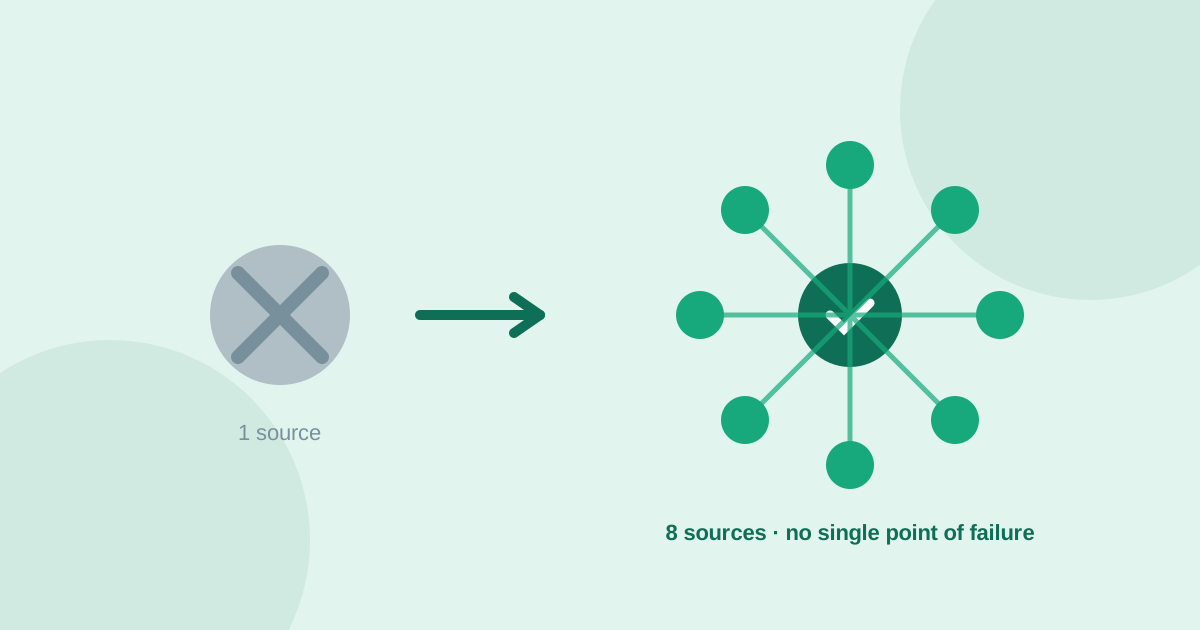 Market Research
Best GummySearch Alternatives in 2026 (Access Ends 30 November)
GummySearch closed to new customers in November 2025, and existing users lose access on 30 November 2026 with all data deleted the next day. Eight alternatives compared on real pricing, real sources, and which half of the job each one actually replaces.
Read article →