
Best Exploding Topics Alternatives in 2026 (Trend Discovery vs. Pre-Build Validation)
October 5, 2026 · 8 min read
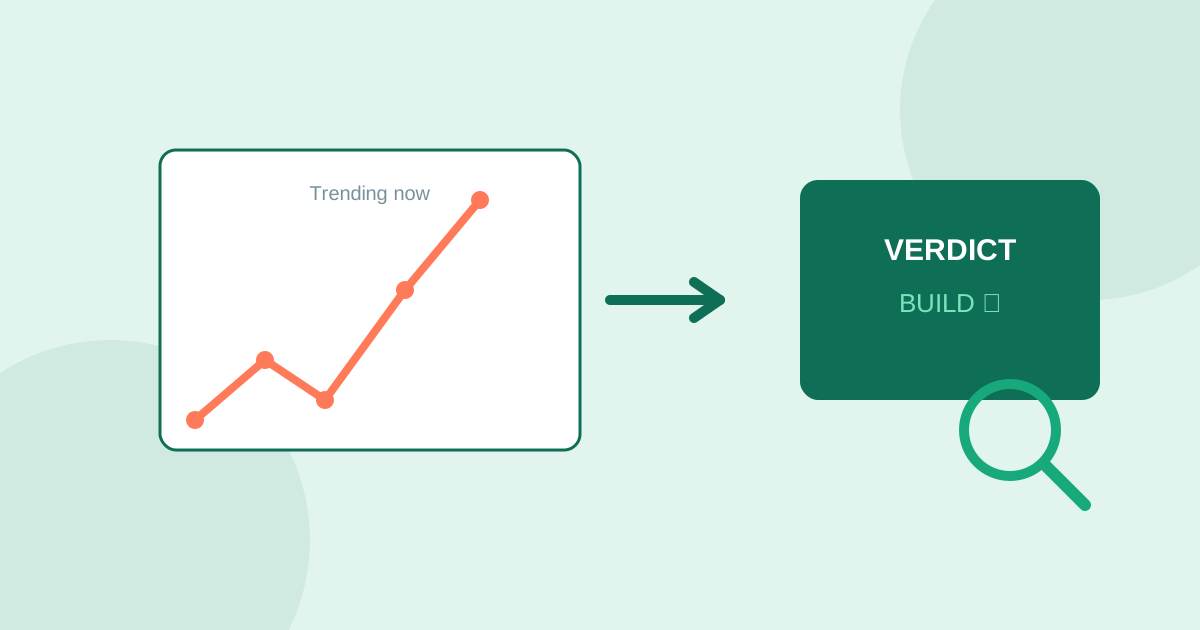
If you are looking at Exploding Topics alternatives, you are probably trying to solve one of two different problems: you want another way to spot a rising trend before it peaks, or you already have a trend in hand and need to know whether a real, buildable pain point sits underneath it. Those are not the same question, and most of the disappointment with trend-discovery tools comes from asking the second question of a tool built to answer the first.
What Exploding Topics actually does
Exploding Topics tracks search, social and e-commerce signals to flag products, ingredients, hobbies and categories whose mentions are accelerating faster than the rest of the internet. Its database and weekly newsletter are genuinely good at one job: telling you that a keyword, a gadget category or a niche ingredient is growing in attention months before it becomes an obvious, crowded trend everyone writes about. For trend-led content, early product sourcing and spotting a wave worth riding, that early-warning signal is valuable and hard to replicate by hand.
Where it stops being enough
The gap is not a feature the tool is missing, it is the question the tool was never built to answer. A rising search curve tells you attention is growing. It does not tell you why, who exactly is frustrated, how much money or time that frustration is costing them, or whether anyone has already built something good enough that the gap is closed. Two topics can show identical growth charts on Exploding Topics: one driven by a genuine, unmet need, the other by a single viral video that everyone searched once and then forgot. The chart looks the same. The market underneath does not.
This is the trap founders fall into most often with trend databases: treating a rising line as permission to build. A trend tells you where attention is moving. It cannot tell you whether the people paying that attention are stuck on a problem badly solved, or just curious for a week. Confusing the two is how founders end up building a competent product for a trend that was already cooling by the time it shipped.
What to use instead, depending on the job
If your job is sourcing an early product idea, spotting a category before competitors notice it, or feeding a content calendar with what is about to be searched more, Exploding Topics and tools like it remain the right category. Swapping it for a validation tool for that specific job would be a downgrade, since validation tools are not built to forecast growth curves months out.
If your job is deciding whether a specific idea, once you already have one in mind, is worth two weeks of building, a rising trend chart is the wrong evidence to lean on. What actually answers that question is reading what real people say about the problem in their own words: the Reddit thread where someone describes exactly what they tried and why it failed them, the one-star Amazon review that names the missing feature, the YouTube comment arguing with the creator about whether the product actually works. A trend line summarizes volume. A complaint shows intent, intensity and the specific gap competitors left open.
Where UserConcern fits
UserConcern is built for that second job, after a trend or a niche has caught your attention and before you commit to building anything inside it. One search cross-checks 8 sources, Reddit, Amazon reviews, YouTube, TikTok, Quora, X/Twitter, Google Trends and AI answers, in about 60 seconds, and returns ranked pain points with the original quotes linked back to their source, an opportunity score and a build-or-skip verdict, in 9 languages across 16 regions. It does not try to spot the next rising category; it answers whether the category you already noticed has a real, specific, underserved complaint behind it, or just a lot of search volume and no clear gap.
The two tools solve adjacent, sequential problems rather than competing ones. A trend-discovery tool is how you find a direction worth looking at. A cross-source validation tool is how you decide whether that direction has an actual problem worth building a product around, or whether the growth chart was the whole story. Many founders who use Exploding Topics for sourcing run the resulting shortlist through a validation pass before they build anything, specifically because a rising trend and a validated pain point are measured differently, and skipping the second check is how a well-timed idea still ends up with nobody buying.
Frequently asked questions
Is Exploding Topics good for validating a startup idea?
Exploding Topics is built to spot rising search and social attention early, not to confirm whether a specific pain point behind that attention is real, specific and underserved. A category can trend for a single viral moment just as easily as for a genuine unmet need, and the growth chart alone cannot tell you which one you are looking at.
What is the difference between Exploding Topics and UserConcern?
Exploding Topics tracks growth curves across products, ingredients and categories to flag what is rising before it peaks. UserConcern cross-checks a specific idea or niche against 8 sources of real complaints (Reddit, Amazon reviews, YouTube, TikTok, Quora, X/Twitter, Google Trends and AI answers) to confirm whether a pain point is real and returns a build-or-skip verdict. One finds directions, the other tests them.
Can I use a trend tool and a validation tool together?
Yes, and this is the most common honest workflow: use a trend-discovery tool to surface categories or products gaining attention, then run the shortlist through cross-source validation before committing time or money, so a well-timed idea and an idea with a real underlying problem stop looking identical.
Why can a rising trend chart still lead to a failed product?
A growth chart measures attention volume, not the reason behind it. A spike driven by one viral post cools as fast as it rose, while a spike driven by a genuine, recurring frustration tends to hold. Without reading the actual complaints behind the numbers, both spikes look the same on a chart, and only one of them is a real market.
More articles
 Market Research
Best GummySearch Alternatives in 2026 (Access Ends 30 November)
GummySearch closed to new customers in November 2025, and existing users lose access on 30 November 2026 with all data deleted the next day. Eight alternatives compared on real pricing, real sources, and which half of the job each one actually replaces.
Read article → Market Research
How to Identify Customer Pain Points: 7 Methods That Actually Work
Customer pain points are the raw material of every successful product. Here are 7 practical methods to find them, from free manual research to AI-powered analysis.
Read article →