
Best DemandHunter Alternatives in 2026 (Tiered Source Access vs. Cross-Source Validation)
September 14, 2026 · 8 min read
DemandHunter is one of the newer entrants in the wave of tools built to answer the question GummySearch used to answer, but it frames itself a step further downstream: not just community monitoring, but "demand validation." You enter a product direction or idea, the tool expands it into related search angles using AI-generated terms and synonyms, scans and filters public discussions for relevant content, clusters what it finds into opportunity cards, and generates a scored judgment, a demand score, a signal-strength read, an MVP scope suggestion, a risk judgment, and any payment-signal language it found, with links back to the original discussions.
DemandHunter is one answer to a question GummySearch used to answer. The wider GummySearch alternatives guide puts eight tools side by side, this one included.
That output layer, especially the MVP scope and risk judgment fields, is a genuine step beyond a plain list of matching threads, and it deserves a fair look. This guide covers what DemandHunter actually does, exactly how its source coverage is split across three price tiers, where that structure is a real strength, and where it runs into a ceiling that a flat, ungated source list doesn't have.
What DemandHunter actually does
The workflow is five steps: enter a product idea or direction, let the tool expand it into related search angles, scan and filter public discussions across its source list, cluster the results into opportunity cards, and read a generated demand score alongside MVP scope and risk notes. Every conclusion links back to the original discussion it was drawn from, so a demand score isn't a black box, you can click through to the actual thread or review that produced it. The platform's own language is careful here, describing itself as built to help you decide faster, not to promise certainty or guarantee an idea will make money, which is a more honest framing than most tools in this category use.
Pricing and how source coverage is gated
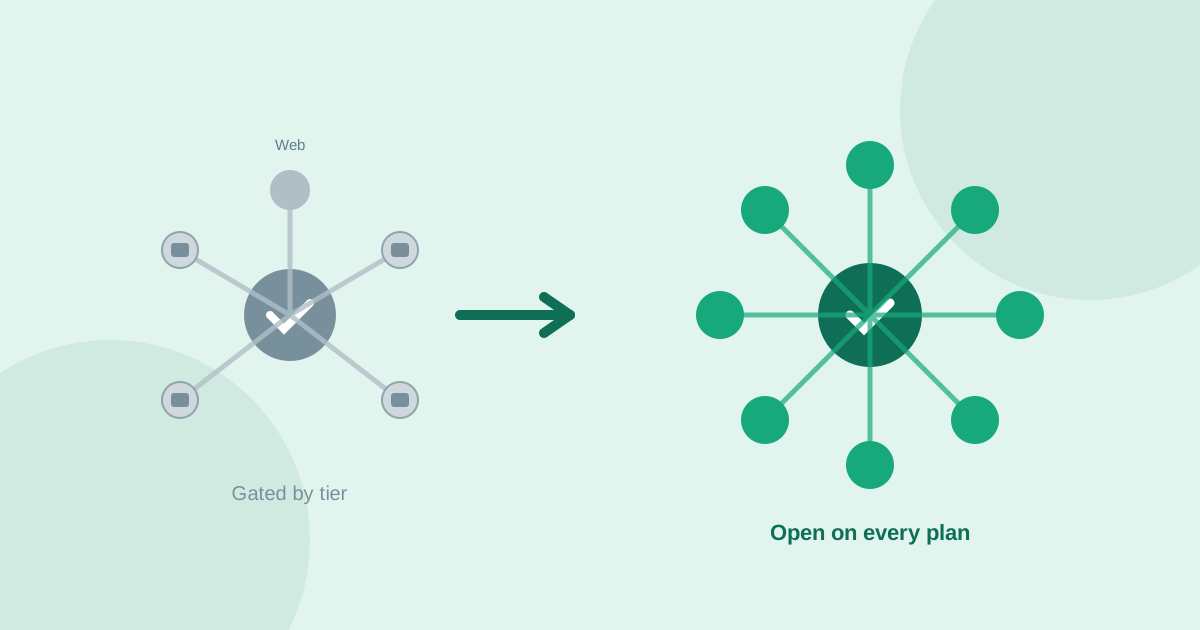
DemandHunter's pricing is where the multi-source pitch gets complicated, because source access is tiered along with everything else. The Free plan, $0 per month, includes one daily standard scan, but that scan covers web sources only, runs with ads, and stores 3 saved reports; additional scans cost $1.99 each. The Lite plan, $9.99 per month, unlocks one daily advanced scan across web, Reddit, X, Hacker News and GitHub, removes ads, and stores 30 saved reports, with bulk scans available at $4.95 for 5 reports. The Pro plan, $19.99 per month and marked as most popular, includes one daily full scan plus 10 included full scans a month, expands coverage to web, Reddit, Hacker News, GitHub, X, YouTube, Polymarket, TikTok and Instagram, stores 100 saved reports, and adds priority access to new data sources, with bulk scans at $4.90 for 10 reports. All tiers offer a 20% discount billed annually, and Pro includes a 3-day free trial.
Where the source list is genuinely interesting
At the Pro tier, DemandHunter's nine-source list is a legitimately broad net for digital-native ideas, and two inclusions stand out as things few competitors in this category offer. Polymarket, a prediction market, is an unusual and genuinely interesting demand signal, since prediction-market pricing reflects real money staked on an outcome rather than just opinion. GitHub coverage is a real advantage for developer-tool and technical-product ideas, surfacing issues and discussions that Reddit-only tools never reach. Combined with the MVP scope and risk judgment synthesis on top of the raw scan, this is a thoughtfully built tool for a founder validating a digital, English-language, online-native idea who's willing to pay for the top tier to unlock it.
Where the tiered structure runs into a ceiling
The structural issue is that the free entry point doesn't actually let you test the tool's core promise. A tool marketed on multi-source demand validation whose free tier is, by its own description, web source only, means the differentiator you'd be evaluating the product for is exactly what's withheld until you pay. Full cross-source scanning only unlocks at the $19.99-per-month Pro tier, and even there, one full scan a day before paying $4.90 per 10-report bulk add-on limits how freely you can iterate across several angles of the same idea in one sitting. The nine sources also still skew toward a specific kind of audience: there's no Amazon review mining, which leaves physical products largely uncovered even on the top tier, no Quora, no Google Trends demand signal, no AI-answer mining, and no stated support for non-English markets. An idea aimed at a physical product, a non-technical audience, or a market outside English and the US produces thinner results here regardless of which tier you're paying for.
Where UserConcern fits
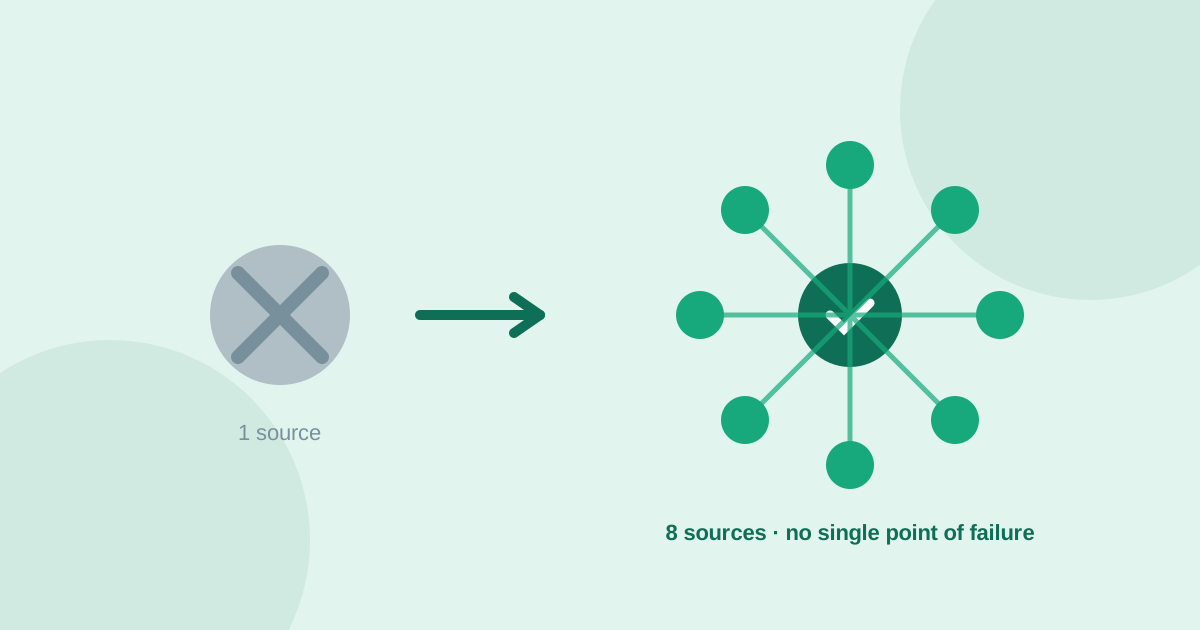
UserConcern takes the opposite approach to access: every plan, including the free one, searches the same 8 structurally different sources, Reddit, Amazon reviews, YouTube, TikTok, Twitter/X, Quora, Google Trends and AI answers, in about 60 seconds, in 9 languages across 16 regions. There's no source-gating between tiers, so a free search tests the actual product rather than a stripped-down preview of it, and because Amazon reviews are included from the start, physical products get covered in a way DemandHunter's roster doesn't reach even on its top tier.
The honest way to choose: if your idea lives in developer tools, technical infrastructure, or a market where a prediction-market signal is genuinely relevant, and you're comfortable paying to unlock cross-source scanning, DemandHunter's Pro tier is a real, thoughtfully built fit. If you want to test the full cross-source claim, including physical products or a non-English market, starting from your very first free search, cross-source validation with no tier-gating answers that more directly. First search on UserConcern is free, no credit card, about 60 seconds.
Frequently asked questions
What is DemandHunter?
DemandHunter is a multi-source demand validation tool. You enter a product idea, it expands the search with AI-generated terms, scans public discussions across its source list, clusters the results into opportunity cards, and returns a demand score, MVP scope suggestion and risk judgment with links back to the original discussions.
How much does DemandHunter cost?
DemandHunter offers a free plan with 1 daily web-only scan, a Lite plan at $9.99/month covering web, Reddit, X, Hacker News and GitHub, and a Pro plan at $19.99/month covering all 9 sources including YouTube, TikTok, Instagram and Polymarket. Annual billing saves 20%, and Pro includes a 3-day free trial.
Does DemandHunter's free plan search multiple sources?
No. DemandHunter's free plan is limited to web sources only. Reddit, X, Hacker News and GitHub require the $9.99/month Lite plan, and full coverage including YouTube, TikTok, Instagram and Polymarket requires the $19.99/month Pro plan.
What is the difference between DemandHunter and UserConcern?
DemandHunter gates its source coverage by pricing tier, from web-only on the free plan up to 9 sources on its $19.99/month Pro plan. UserConcern searches the same 8 structurally different sources, including Amazon reviews for physical products, Quora and Google Trends, on every plan including the free one, in 9 languages, with no source-gating between tiers.
Is DemandHunter good for validating a physical product idea?
Not especially. None of DemandHunter's nine sources, even on the Pro tier, include Amazon or other e-commerce review mining, so physical and hybrid products are underrepresented regardless of price tier. A tool that includes Amazon reviews by default, like UserConcern, is a more direct fit for physical-product validation.
More articles
 Market Research
Best GummySearch Alternatives in 2026 (Access Ends 30 November)
GummySearch closed to new customers in November 2025, and existing users lose access on 30 November 2026 with all data deleted the next day. Eight alternatives compared on real pricing, real sources, and which half of the job each one actually replaces.
Read article → Market Research
How to Identify Customer Pain Points: 7 Methods That Actually Work
Customer pain points are the raw material of every successful product. Here are 7 practical methods to find them, from free manual research to AI-powered analysis.
Read article →