
Best CatchIntent Alternatives in 2026 (Intent Monitoring vs. Pre-Build Validation)
August 3, 2026 · 8 min read
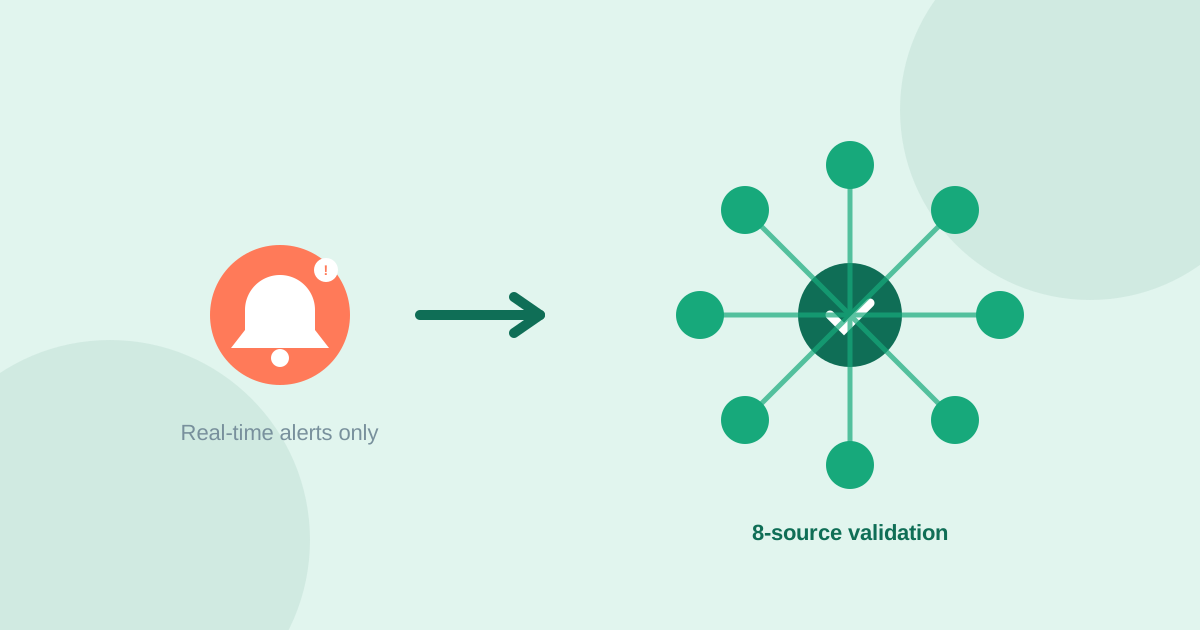
If you are comparing CatchIntent against other options, you are likely trying to solve one of two problems: catching high-intent buying conversations the moment they happen, or figuring out whether an idea is worth building before you have a product to sell into those conversations at all. CatchIntent is built specifically for the first problem, and it is worth understanding exactly what it does well before deciding whether it is also the right tool for the second.
What CatchIntent actually does
CatchIntent positions itself as an AI-powered buyer intent detection tool that turns social conversations into qualified leads. It continuously monitors Reddit, X (Twitter), Hacker News and Bluesky, tracking thousands of conversations around the clock to find people actively describing a problem your product could solve. Its core pitch is noise reduction: rather than a raw keyword match that floods you with irrelevant chatter, it claims to filter out more than 95% of the noise so what reaches you is a shortlist of genuinely high-intent conversations, delivered as instant alerts through email, Slack, Discord, Telegram or webhooks. Pricing runs $49/month for a Basic plan (3 listeners, 100 signals) and $99/month for Pro (10 listeners, 500 signals), with a 7-day free trial to test the filtering before committing.
That is a meaningfully broader monitoring footprint than a Reddit-only tool. Four platforms instead of one means CatchIntent is less exposed to the single-platform risk that ended GummySearch, and the noise-filtering layer is a genuine value-add over building your own keyword rules from scratch across four different APIs.
For the wider picture, our comparison of the GummySearch replacements covers eight tools and separates the ones that monitor Reddit from the ones that actually research an audience.
Where it's genuinely useful
If your business already exists, or your product is far enough along that you know what a qualified lead looks like, CatchIntent is solving a real and time-consuming problem: sifting through thousands of daily posts across four platforms to find the handful of people who are actually in-market right now. The listener-and-signal pricing structure is built for exactly that ongoing job, and routing alerts straight into Slack or Discord means a sales or growth team can act on a hot conversation within minutes instead of finding it a week later during a manual search. For lead generation and social selling, that speed is the entire value proposition.
Where monitoring hits a ceiling for validation
The limitation is not platform coverage, which is genuinely above average for this category. It is the job the product is built for. CatchIntent is designed to answer "is someone in-market right now," which presumes you already know your product, your pitch and your qualification criteria well enough to set up listeners and recognize a signal when it arrives. It is not designed to answer a question that comes before all of that: is this problem common enough, painful enough, and underserved enough to justify building a product around it in the first place. Those are different jobs, and a tool tuned for real-time lead alerts is not the right instrument for a pre-build market assessment, no matter how good its noise filtering is.
There is also a coverage gap worth naming plainly. Reddit, X, Hacker News and Bluesky are all text-first, discussion-style platforms, and Hacker News in particular skews heavily toward a technical, English-speaking audience. None of them are where people complain about a physical product's packaging, a mobile app's onboarding flow, or a consumer purchase they regretted, the way Amazon reviews, YouTube comments and TikTok comments routinely do. A consumer product, an e-commerce niche, or a service business validating demand will find comparatively thin signal in CatchIntent's four sources, because that is not where those buyers tend to voice frustration. The product also does not make claims about multilingual or multi-region coverage, so a non-English-speaking market is unlikely to be well represented in what it surfaces.
What to use instead, depending on the job
If your job is catching real-time, high-intent conversations for an existing product or service, CatchIntent's combination of four-platform monitoring and aggressive noise filtering is a well-built, purpose-made choice, and there is no reason to look elsewhere for that specific job. If your job is deciding whether an idea deserves to become a product at all, before you have a pitch, a qualification list, or even a name, real-time lead monitoring is the wrong instrument regardless of how many platforms it watches, because it is built to find people ready to buy something that already exists, not to test whether a problem is real and underserved.
Where UserConcern fits
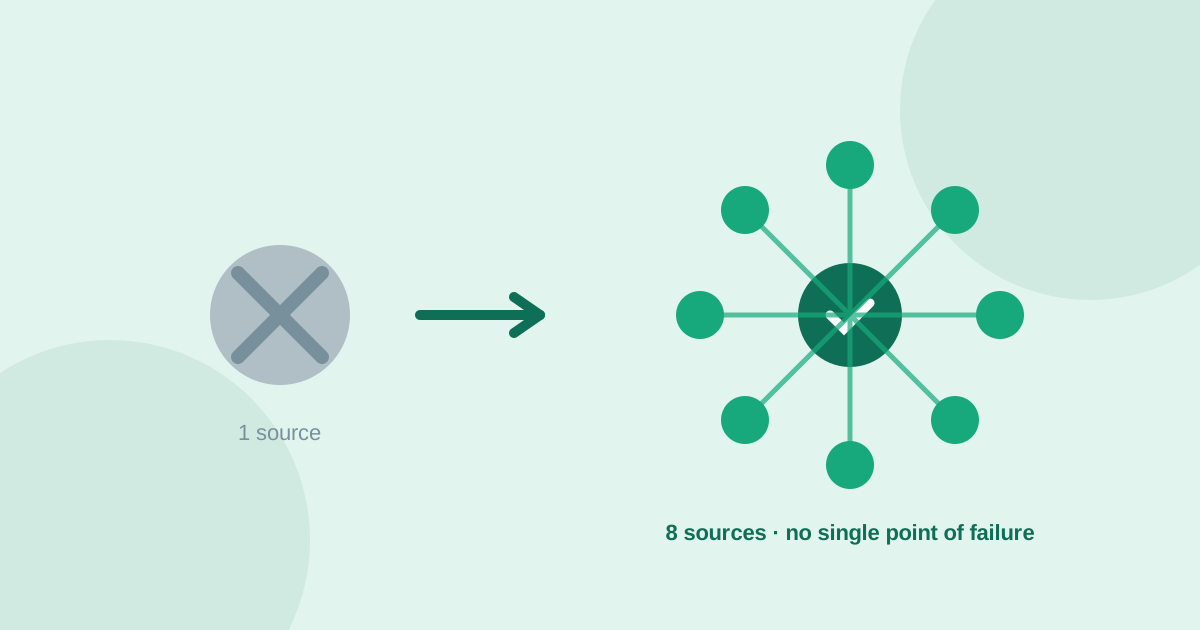
UserConcern is built for that earlier job. One search cross-checks 8 sources, Reddit, Amazon reviews, YouTube, TikTok, Twitter/X, Quora, Google Trends and AI answers, in about 60 seconds, in 9 languages across 16 regions, and returns ranked pain points with the original quotes linked back to their source, an opportunity score, and a build-or-skip verdict. It deliberately includes the consumer-facing, review-and-video sources that intent-monitoring tools skip, because those are where product-level frustration, not just in-market buying signals, actually lives.
The honest way to choose: if you already have a product and need to catch buying-intent conversations as they happen across Reddit, X, Hacker News and Bluesky, CatchIntent is built for exactly that and does it well. If you are still deciding whether to build the product in the first place, cross-source validation is the step that comes first, and many founders reasonably use both in sequence: validate the idea, then switch on real-time intent monitoring once there is something to sell.
Frequently asked questions
What is CatchIntent?
CatchIntent is an AI-powered buyer intent monitoring tool that tracks Reddit, X (Twitter), Hacker News and Bluesky for conversations from people actively looking for a solution like yours. It filters out most of the noise from those platforms and sends real-time alerts via email, Slack, Discord, Telegram or webhooks. Pricing is $49/month for a Basic plan (3 listeners, 100 signals) or $99/month for Pro (10 listeners, 500 signals), with a 7-day free trial.
Is CatchIntent good for validating a new idea before building it?
It is built for a different, later job: finding people who are already in-market for something like your product, once you know what your product and qualification criteria are. It is not designed to test whether a problem is common, painful or underserved enough to build around in the first place, which is a question that requires reading complaint and review language, not buying-intent signals.
What is the main difference between CatchIntent and UserConcern?
CatchIntent monitors four discussion platforms in real time to surface people ready to buy now. UserConcern cross-checks 8 sources, including consumer-facing platforms like Amazon reviews, YouTube and TikTok that CatchIntent does not cover, to validate whether a pain point is a real, buildable market before a product exists to sell into intent signals at all.
Can I use both an intent-monitoring tool and a validation tool?
Yes, and the sequence matters: validate the idea first with a cross-source tool so you know the problem is real and underserved, then turn on real-time intent monitoring once you have a product and a qualification list, so you can act quickly on buying-intent conversations as they happen.
More articles
 Market Research
Best GummySearch Alternatives in 2026 (Access Ends 30 November)
GummySearch closed to new customers in November 2025, and existing users lose access on 30 November 2026 with all data deleted the next day. Eight alternatives compared on real pricing, real sources, and which half of the job each one actually replaces.
Read article → Market Research
How to Identify Customer Pain Points: 7 Methods That Actually Work
Customer pain points are the raw material of every successful product. Here are 7 practical methods to find them, from free manual research to AI-powered analysis.
Read article →