
Best AnswerThePublic Alternatives in 2026 (Search Questions vs. Validated Pain Points)
October 10, 2026 · 9 min read
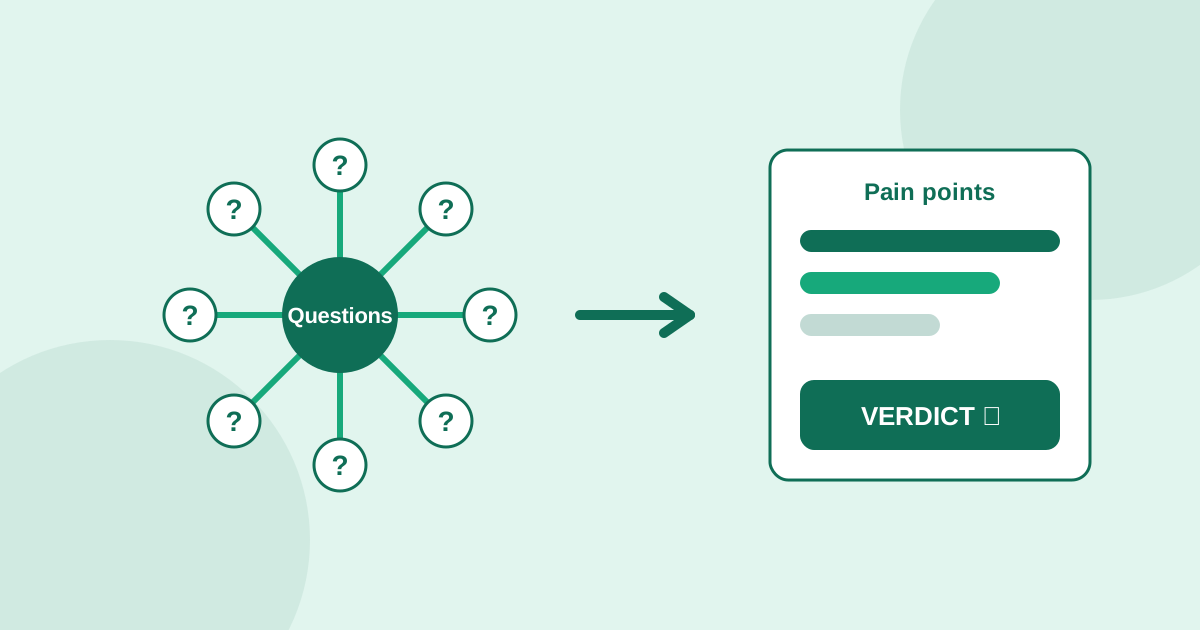
People look for AnswerThePublic alternatives for two very different reasons. Some want another keyword and question research tool for SEO and content planning, usually because of search limits or price. Others started using it for something it was never really designed for, working out whether a business idea has real demand behind it, and found that a wheel of search questions left them no closer to a decision. This article is mostly for the second group, though it tries to be fair to the tool along the way, because for its actual job AnswerThePublic is good.
What AnswerThePublic actually does
AnswerThePublic describes itself as a keyword research and search listening platform. You enter a topic, and it surfaces the questions, prepositions, comparisons and related searches that real people are typing into search engines around that topic, across multiple languages and regions. The output is famous for its visual layout: a wheel with your seed term in the middle and branches for who, what, when, where, why, how, can, are, will, plus prepositions such as for, with, without and near, and comparisons such as versus, or and like.
It also offers Search Listening Alerts, which monitor a topic and notify you when the questions people ask about it change. Its own positioning names the audience clearly: marketers, SEOs, content creators, PR teams and consumer insight researchers who want content ideas and campaigns grounded in real search data. At the time of writing its pricing page lists three paid plans, Starter, Growth and Business, at $20, $99 and $199 a month, with lower rates on annual billing. Check the page yourself before you buy, since plans and regional prices change.
What it does well
The strength of search-question data is that it is unprompted and private. Nobody performs for an audience in a search box. People type things there that they would not post under their own name, which makes question data a genuinely useful window into what an audience is curious, confused or worried about. A single query for a seed term returns hundreds of real phrasings in a few seconds, grouped in a way that makes patterns jump out: if a third of the branches are some version of is it safe, you have learned something about the audience before reading a single forum post.
For content work that is close to ideal. Each branch is a candidate headline, an FAQ entry, a section of a buyer's guide or a video title. If your job is building a content calendar, briefing a writer, structuring a pillar page or finding the long-tail questions a competitor's blog has not answered, AnswerThePublic and tools like it are the right category, and replacing one with a validation tool would be a downgrade.
Where search questions stop being validation
The limit is not a missing feature. It is the nature of the data. A search query is a few words with no story attached, and deciding whether to build something depends almost entirely on the story.
First, a question tells you someone is curious, not that they are stuck. How to clean a cast iron pan is searched constantly, and it is answered completely by a two-minute video. Huge question volume, no business. The queries that hide real businesses look the same on the wheel as the ones that are fully solved by free content, and nothing in the query itself separates them.
Second, a query does not tell you what the person already tried. The most valuable sentence in market research is some version of I bought this, it failed in this specific way, so now I do this awkward workaround instead. That sentence names the incumbent, the gap and the proof of effort in one go. It appears in reviews and forum threads. It never appears in a search box, because nobody types their history into a query.
Third, a query carries no intensity. Is X worth it could come from someone idly browsing or from someone about to spend a month's rent. Complaints carry their own weight: the length of the post, the money mentioned, the number of people replying same here. Search questions flatten all of that into a phrase of identical size on a chart.
Fourth, the wheel shows questions, not answers, and the gap is in the answers. If the top results already resolve the question well, the need is met. If people click through, buy the recommended product and then leave two-star reviews saying it did not work for their situation, there is an opening. You only find that by reading what happens after the search.
The alternatives, by the job you actually have
If the job is SEO and content planning, stay in the keyword-research category. Tools built around People Also Ask data, autocomplete suggestions and search volume all solve versions of the same problem, and the right choice comes down to search limits, how you like the data presented and what you already pay for. For that job a pain-point tool is the wrong answer, including ours.
If the job is spotting what is rising before it peaks, you want a trend-discovery tool rather than a question tool. Question data describes what is being asked now. It says little about the direction of travel.
If the job is monitoring conversations about a brand or a keyword as they happen, a social listening or keyword alert tool fits better. AnswerThePublic's own alerts cover changes in search questions, which is related but not the same as being told when someone posts about your category on a forum.
If the job is deciding whether an idea is worth building, you need the material search questions leave out: the complaints, the failed purchases and the workarounds, in the customer's own words, from more than one place. You can gather that by hand. Search the niche on Reddit and sort by top for the past year, read the two- and three-star Amazon reviews on the leading products, read the comments on the most-watched YouTube videos on the topic. It works, and it takes most of a weekend per idea.
Where UserConcern fits
UserConcern automates that last job. One search cross-checks 8 sources, Reddit, Amazon reviews, YouTube, TikTok, Quora, X/Twitter, Google Trends and AI answers, in about 60 seconds, and returns ranked pain points with the original quotes linked back to where they were posted, an opportunity score and a build-or-skip verdict, in 9 languages. It does not produce a question wheel, search volumes or a content calendar, and it is not a replacement for keyword research.
The reason for cross-checking is the same reason a single wheel of questions is not enough. Any one source has its own bias: Reddit skews toward people who enjoy arguing, Amazon reviews only cover products that already exist, search data hides the story. A complaint that shows up independently in a forum thread, a product review and a video comment section is much harder to explain away as a quirk of one platform.
Using both together
The two kinds of tool are sequential rather than competing, and the cheapest good workflow uses both. Start with question research to map what an audience asks about a topic and to notice which clusters look like worry or friction rather than curiosity: questions containing without, alternative, not working, safe, worth it, cancel. Those clusters are hypotheses. Then take each one to complaint data and check whether real people describe the problem in detail, name what they tried and say what it cost them. Most clusters will dissolve at that step, which is the point. The ones that survive have both search demand and a documented gap behind them.
After you build, the question data becomes useful again, this time for its intended purpose: the same branches that pointed you at the problem are the articles and FAQ entries that will bring people with that problem to your site.
Frequently asked questions
Is AnswerThePublic good for validating a business idea?
It is a useful first step and a weak final one. It shows which questions people type into search engines about a topic, which confirms interest and reveals how an audience phrases things. It does not show what those people already tried, how much the problem costs them, or whether existing products have already closed the gap, and those are the facts a build decision depends on.
What is the difference between AnswerThePublic and UserConcern?
AnswerThePublic is a keyword research and search listening platform that surfaces questions, prepositions, comparisons and related searches for a topic, mainly for content and SEO work. UserConcern cross-checks an idea against 8 sources of real complaints and discussions (Reddit, Amazon reviews, YouTube, TikTok, Quora, X/Twitter, Google Trends and AI answers) and returns ranked pain points with source quotes and a build-or-skip verdict. One maps what people ask, the other tests whether there is an unsolved problem behind it.
Why are search questions not the same as pain points?
A search question is a few words with no context. It cannot tell you whether the person was mildly curious or desperate, what they had already bought, or whether the first result solved their problem. A pain point is a described experience: what went wrong, what was tried, and what it cost. Many heavily searched questions are fully answered by free content and hide no business at all.
Can I use AnswerThePublic and a pain-point tool together?
Yes, and it is the workflow we would recommend. Use question research to find clusters that suggest friction, such as questions containing alternative, without, not working or worth it. Treat each cluster as a hypothesis, then check it against reviews and forum discussions to see whether people describe a specific, costly, unsolved problem. Keep the question data for content planning once you have something to sell.
What should I use instead of AnswerThePublic for SEO?
Another keyword research tool, not a validation tool. If your goal is content ideas, FAQ coverage and long-tail keywords, look at tools built on People Also Ask data, autocomplete suggestions and search volume, and choose on search limits, presentation and price. UserConcern is not built for that job.
More articles
 Market Research
Best GummySearch Alternatives in 2026 (Access Ends 30 November)
GummySearch closed to new customers in November 2025, and existing users lose access on 30 November 2026 with all data deleted the next day. Eight alternatives compared on real pricing, real sources, and which half of the job each one actually replaces.
Read article → Market Research
How to Identify Customer Pain Points: 7 Methods That Actually Work
Customer pain points are the raw material of every successful product. Here are 7 practical methods to find them, from free manual research to AI-powered analysis.
Read article →