
How to Mine AI Chatbot Answers for Real Customer Pain Points (ChatGPT, Perplexity, Claude)
August 10, 2026 · 8 min read
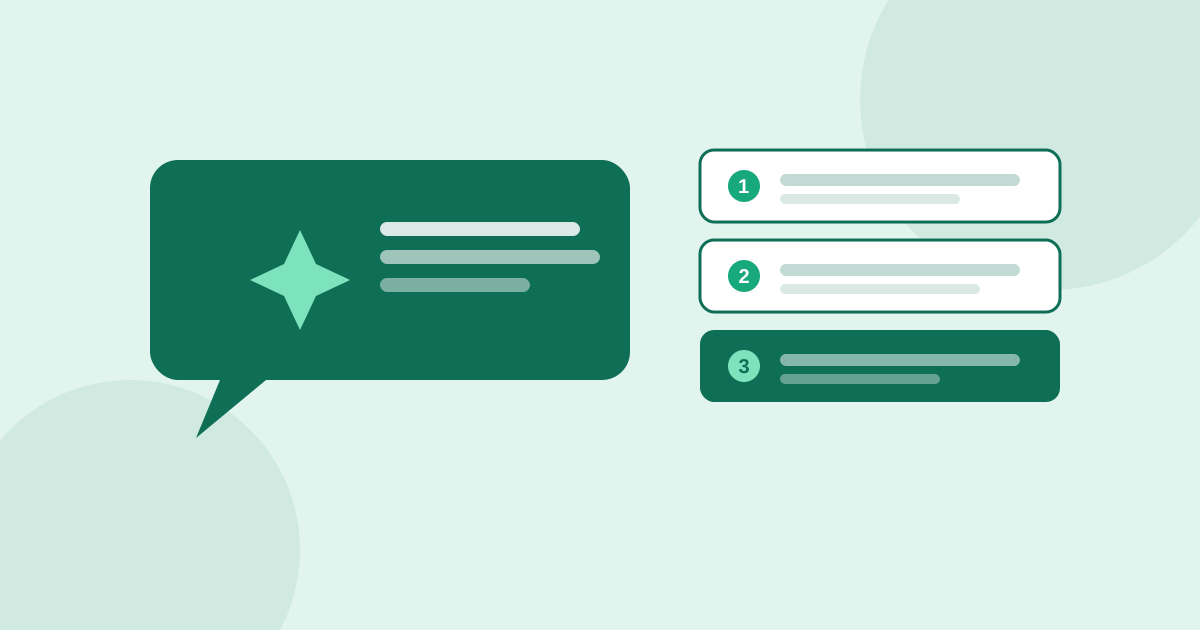
A growing share of buying research now starts with a question typed into ChatGPT, Perplexity or Claude instead of a search engine: what's the best app for tracking freelance invoices, is there a tool that helps me plan a wedding on a budget, what should I use instead of a spreadsheet for this. The answer that comes back shapes what that person tries first, and increasingly, what they never bother searching for elsewhere at all. That makes AI answers a real, fast-growing demand surface, and one almost nobody researching a new idea thinks to read carefully.
This guide is about mining that surface deliberately: asking the same kinds of pain-framed questions a real buyer would ask, reading the answers for what they reveal about the current competitive landscape, and paying close attention to the moments an assistant hedges, lists several mediocre options, or cannot give a confident single recommendation. Those moments are gaps, described in plain language, by a system that has read more of the public internet's opinions than any one person ever could.
Why AI answers are a different kind of signal
Reddit threads, Amazon reviews and YouTube comments are raw complaints, unfiltered and unprocessed. An AI answer is the opposite: a synthesized, already-processed summary of what the model's training data suggests is true about a category, including which products are well regarded and which questions do not have a clean answer yet. That makes AI answers less useful for finding the exact words a frustrated buyer used, and more useful for a different job: quickly mapping the existing competitive landscape and spotting the specific sub-questions where even a system trained on enormous amounts of text still cannot give a confident, singular recommendation.
Step 1: ask the question your buyer would actually ask
Skip your product category name and ask the way a real person in the moment of frustration would. Instead of best CRM for small agencies, try something closer to what a first-time user might type: I keep losing track of client follow-ups in email, what should I use instead. Specific, situational phrasing surfaces a more honest answer than a generic best of prompt, because it forces the assistant to reason about a real constraint instead of reciting a familiar top-five list.
Step 2: run the identical prompt across at least three assistants
Ask the exact same question, worded identically, to ChatGPT, Perplexity and Claude, and compare the answers side by side. Strong agreement across all three, the same two or three names recommended every time with confidence, tells you the category has a clear, well-established leader and any new entrant needs a sharp wedge to compete. Disagreement between assistants, or a different shortlist each time, is itself a signal: it means there is no obvious consensus answer yet, which is often exactly where a gap lives.
Step 3: read for hedging language, that is where the gap lives
Watch for the specific phrases an assistant uses when it does not have a confident answer: it depends on your specific needs, there isn't a single tool that does all of this well, you may need to combine two options, or a long list of five or six alternatives with no clear winner named. A generic best of answer with one obvious top pick means the category is served. A hedge, a combination-of-tools workaround, or a noticeably long list with no standout means the assistant is doing its best with a genuine gap in what actually exists.
Step 4: count how many distinct products actually get named
Ask a handful of related questions in the same niche and tally how many different products come up across all of them. A small, repeated set of two or three names across every question you ask points to a consolidated, competitive category. A wide, constantly shifting list of different tools with no repeat winners suggests a fragmented market where nothing has become the obvious default yet, which is often more workable territory for a focused new entrant than a category one incumbent already owns.
Step 5: ask the follow-up question a real buyer would ask next
Buyers rarely stop at one question. After the first recommendation, ask the natural follow-up: what do people complain about with that, or is there a cheaper or simpler alternative for someone just starting out. This second-layer question often surfaces the specific limitation of the leading option directly, since the assistant has effectively been trained on public complaints about it too, and it can hand you the exact wedge a challenger would need without you ever leaving the chat window.
The trap: AI answers lag reality and mirror popularity, not truth
An assistant's knowledge reflects a training snapshot plus whatever it can retrieve live, and confident-sounding phrasing does not mean the underlying information is current or complete. A tool that shut down last month, or a startup that launched last week, may not be reflected accurately yet. AI answers also mirror whatever was written about most often online, which rewards popularity and marketing reach over quality, the same bias that affects any single source. Never treat an AI's recommendation, or its hedge, as proof on its own. Cross-check what you find against real, dated complaints from Reddit, Amazon reviews or YouTube comments before concluding a gap is real rather than an artifact of what the model happened to read most.
Putting it together
A focused AI-answer research session looks like this: fifteen minutes drafting five to eight situational, pain-framed questions in your niche, twenty minutes running each one across three assistants and noting agreement, hedges and named products, and fifteen minutes asking the natural follow-up question on the most promising thread. Then cross-check whatever pattern emerges against at least one raw complaint source before acting on it. UserConcern folds this AI-answer layer into its search automatically, checking it alongside Reddit, Amazon reviews, YouTube, TikTok, Quora, X and Google Trends in one pass, so a gap an assistant hedges on only counts once real buyer complaints confirm it too.
Frequently asked questions
Can ChatGPT or Perplexity actually help validate a business idea?
Indirectly, yes. Asking the same pain-framed question across ChatGPT, Perplexity and Claude quickly maps the existing competitive landscape and surfaces moments where the assistant hedges or cannot name a confident single recommendation. That hedge is a useful early signal of a gap, but it should be treated as a starting point to investigate, not proof on its own.
What does it mean when an AI assistant hedges on a recommendation?
Phrases like it depends on your needs, there isn't a single tool that does this well, or a long list with no clear winner usually mean the training data the model drew on does not contain an obvious, well-regarded answer for that specific situation. That is often where a genuine, underserved gap lives, though it still needs to be confirmed against real complaints.
Are AI chatbot answers reliable for market research?
They are useful for mapping what already exists and where consensus is weak, but they reflect a training snapshot and can lag recent product launches or shutdowns, and they tend to favor whatever was written about most online rather than what is actually best. Always cross-check an AI-surfaced gap against dated, real complaints from Reddit, reviews or comments before trusting it.
How is mining AI answers different from mining Reddit or reviews?
Reddit, reviews and comments are raw, unprocessed complaints in a buyer's own words. AI answers are already synthesized recommendations, which makes them faster for mapping a competitive landscape but weaker for hearing the exact language and intensity of real frustration. The two are complementary: use AI answers to find where the map is thin, then use raw complaint sources to confirm the gap is real.
More articles
 Market Research
Best GummySearch Alternatives in 2026 (Access Ends 30 November)
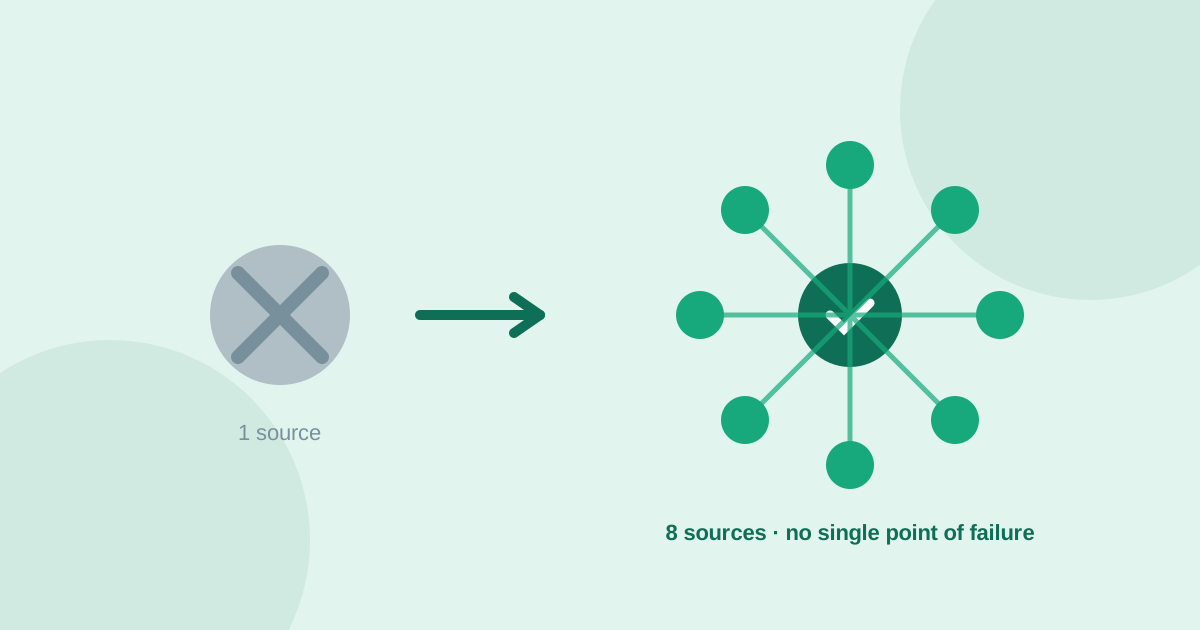
GummySearch closed to new customers in November 2025, and existing users lose access on 30 November 2026 with all data deleted the next day. Eight alternatives compared on real pricing, real sources, and which half of the job each one actually replaces.
Read article → Market Research
How to Identify Customer Pain Points: 7 Methods That Actually Work
Customer pain points are the raw material of every successful product. Here are 7 practical methods to find them, from free manual research to AI-powered analysis.
Read article →