
How to Write a Product Listing From Real Customer Complaints (Amazon, Etsy and Shopify)
October 12, 2026 · 9 min read
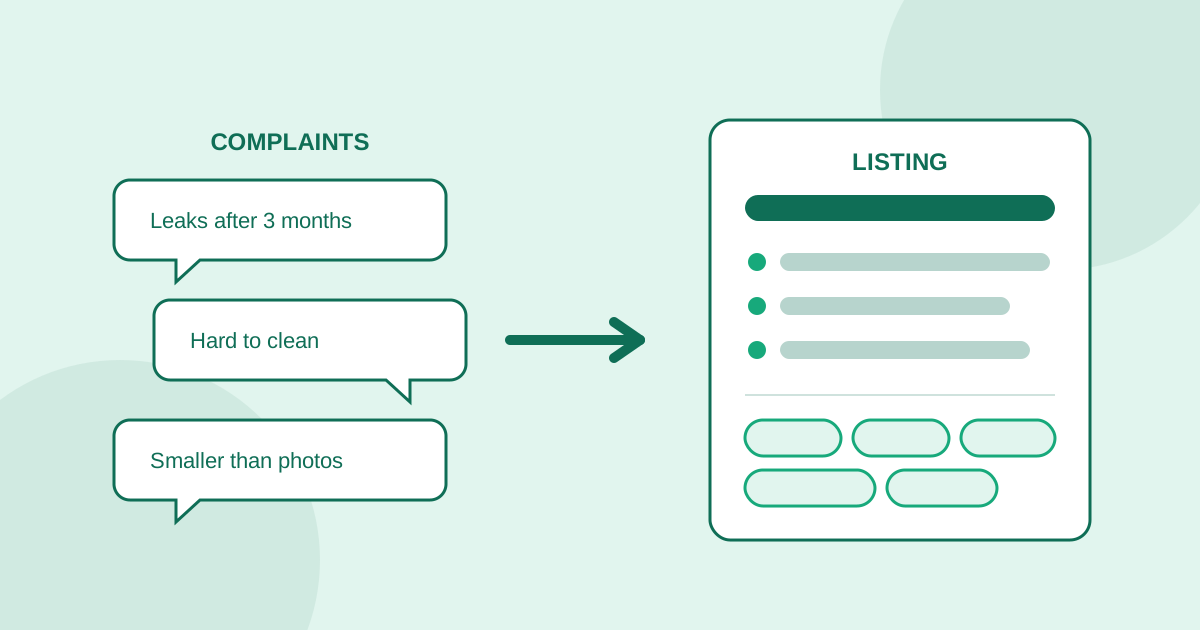
By the time a product is ready to list, most sellers have already done the hard research. They read the reviews of competing products, found the complaint that kept repeating and built or sourced something that fixes it. Then they write the listing, and almost all of that research disappears. The title becomes a string of features. The bullets describe materials and dimensions. The one thing that made the product worth making, the specific frustration it removes, is mentioned in passing or not at all.
This guide is about closing that gap. It covers how to carry complaint research through into the listing itself: which complaints to use, how to turn them into titles, bullets, tags and descriptions, and what changes between Amazon, Etsy and your own Shopify store. The method works by hand with a spreadsheet. The last section shows where UserConcern speeds it up.
Why complaints make better copy than features
A buyer arriving at your listing has usually seen several similar products already, and often owned one. They are not asking what this product is. They are asking whether it will let them down in the same way the last one did. A feature list does not answer that question. A sentence that names the exact failure and says what you did about it does.
Compare two bullets for the same water bottle. The first says premium leak-proof lid with silicone seal. The second says the lid seal is a single removable ring, so it does not trap mould and does not start leaking after a few months of washing. Both describe the same part. The second one was written by someone who read the two-star reviews, and a buyer who has thrown away a mouldy, leaking bottle recognises their own experience in it immediately.
There is a second, more practical benefit. Complaints contain the words buyers actually use, and those are frequently not the words sellers use. A seller writes ergonomic handle. Buyers write hurts my wrist. A seller writes high-capacity. Buyers write fits a full week of meal prep. People search the way they talk, so the phrasing in complaints is also a source of search terms that feature-led keyword lists tend to miss.
Step one: collect the complaints and keep the exact wording
If you validated the product properly you already have most of this. If not, gather it now from at least three places: the two- and three-star reviews on the closest competing products, the Reddit threads where people ask for recommendations in the category, and the comments under the most-watched YouTube reviews. Middle-rated reviews are the most useful, because the buyer liked the product enough to explain precisely what went wrong.
Copy the complaints word for word. Paraphrasing at this stage throws away the thing you came for. Then group them. In most categories ten or twenty raw complaints collapse into four to six themes: it broke, it did not fit, it was hard to clean, it arrived damaged, it was smaller than the photos suggested, the instructions were useless.
Rank the themes by two things: how often they appear, and whether they appear in more than one source. A complaint found only in one product's reviews may be that product's flaw. A complaint found in reviews, in a forum thread and in video comments is a category-wide worry, and those are the ones your listing must answer.
Step two: sort each complaint into one of three piles
Not every complaint belongs in the copy. Sort each theme honestly.
The first pile is complaints your product genuinely solves. These are your headline material. Be strict: solves means you can point at the design decision, the material or the process that makes the difference, and ideally show it in a photo.
The second pile is complaints your product does not solve but that you can defuse with clear information. Sizing is the classic case. You may not be able to make the product fit everyone, but you can put exact dimensions and a scale photo where nobody can miss them, so that the wrong buyer does not order and the right buyer orders with confidence. Setting expectations accurately prevents the next round of bad reviews.
The third pile is complaints your product shares with the competition. Leave these out of the copy and do not write around them with vague reassurance. Claiming to fix something you have not fixed produces exactly the reviews you were mining an hour ago, this time on your own listing. If the third pile contains the most common complaint in the category, that is a finding about the product, not the copy.
Step three: write each part of the listing from the piles
Title. Lead with what the product is, in the plain words buyers search for, then add the single most important thing it fixes. One solved complaint in the title is enough. A title that tries to answer everything reads as keyword stuffing and answers nothing.
Bullets. Give each of the top complaints from the first pile its own bullet, in order of how often it appeared. A reliable structure is the worry, then the fix, then the proof: what tends to go wrong with products like this, what yours does differently, and something concrete the buyer can verify, such as a measurement, a material, a test or a guarantee. Use the buyer's phrasing for the worry and your own precise language for the fix.
Description. This is where the second pile goes. Use it to set expectations: exact dimensions, what is and is not included, who the product is not right for, care instructions. Sellers avoid saying who a product is not for, and it is one of the most trust-building sentences a listing can contain.
Images. Every claim in the first pile should have a photo that shows it. If the bullet says the seal comes out in one piece, show it out, in a hand, in normal light. Buyers who have been burned before believe pictures over adjectives.
Keywords and tags. Go back through the raw complaints and pull out the nouns and phrases buyers used for the product, the problem and the use case. These go where each platform keeps its search terms, which is the main thing that differs between them.
What changes on Amazon, Etsy and Shopify
On Amazon, the listing is built around a title, a set of bullet points, a description and backend search terms that shoppers never see. The backend field is the natural home for buyer phrasing that would read awkwardly in visible copy, such as common alternative names and problem-led phrases. Amazon's style rules and length limits vary by category and change over time, so check the current guidelines for your category rather than relying on a number from any article.
On Etsy there are no bullet points in the same sense. The work is done by the title, the description and the tags, of which a listing can have up to 13. Etsy buyers often search by occasion, recipient and style as much as by product type, so complaint research here should also capture how people describe what they were looking for: a gift for a new dad that is not a mug, a wedding sign that does not look mass-produced. The opening lines of the description matter most, since that is what a buyer sees first.
On your own Shopify store, nobody is searching inside a marketplace, so the page has a different job. Visitors arrive from an ad, a social post or a search engine, and the page has to do all the convincing itself. There is more room, so the worry, fix and proof structure can become full sections with images, and the buyer phrasing you collected doubles as search-engine keywords for the product page and for supporting blog content.
Doing it faster in UserConcern
The collecting and grouping in step one is what a UserConcern search does: it cross-checks 8 sources, including Reddit, Amazon reviews, YouTube, TikTok, Quora and X/Twitter, in about 60 seconds and returns ranked pain points with the original quotes linked, so you keep the exact wording without a weekend of copying and pasting. Review Intelligence goes deeper on what buyers praise and criticise about specific existing products.
Two Pro features then handle the writing steps. The Keyword Extractor takes the pain points from a search and returns three lists: Amazon backend keywords, up to 13 Etsy tags and SEO blog keywords, each with a copy button. The Listing Copy Generator takes a product name, a platform (Amazon, Etsy or Shopify) and, optionally, the customer pain points you want addressed, and returns a product title, bullet points, a product description and a set of recommended keywords.
Treat the output as a strong first draft rather than a finished listing. The tool does not know which complaints your product truly solves. Only you know that, which is why the sorting in step two has to be yours. Paste in only the pain points from your first and second piles, then check every claim in the draft against the actual product, check the result against the platform's current rules, and rewrite anything that promises more than you can show in a photo.
The research you did to choose the product is the same research that sells it. A listing written from real complaints tells the buyer you understand what went wrong last time, which is a more persuasive message than any feature, and one your competitors cannot copy without doing the reading themselves.
Frequently asked questions
Why should I use customer complaints to write a product listing?
Because most buyers have already seen or owned a similar product and want to know whether yours will fail the same way. Copy that names the specific failure and shows what you did about it answers that question directly. Complaints also contain the exact words buyers use, which are often different from seller language and make useful search terms.
Where do I find the complaints to base my listing on?
Read the two- and three-star reviews on the closest competing products, the Reddit threads where people ask for recommendations in your category and the comments on popular YouTube reviews. Copy the wording exactly, group it into themes, and prioritise the themes that appear in more than one source, since those are category-wide worries rather than one product's flaw.
Should I mention problems my product does not solve?
Do not claim to fix them, and do not write around them with vague reassurance. If clear information would help, such as exact dimensions or a statement of who the product is not suited to, include it in the description to set expectations. If the most common complaint in the category is one your product shares, treat that as a product problem rather than a copywriting problem.
How is writing an Etsy listing different from an Amazon listing?
An Amazon listing relies on a title, bullet points, a description and hidden backend search terms. An Etsy listing relies on the title, the description and up to 13 tags, and buyers often search by occasion, recipient and style as well as product type. The same complaint research feeds both, but the buyer phrasing goes into different fields. Always check each platform's current guidelines for length and style rules.
Can UserConcern write my listing for me?
It can write a first draft. On the Pro plan, the Keyword Extractor turns the pain points from a search into Amazon backend keywords, Etsy tags and SEO blog keywords, and the Listing Copy Generator produces a title, bullet points, a description and recommended keywords for Amazon, Etsy or Shopify. You still need to decide which complaints your product genuinely solves and check every claim against the real product before publishing.
More articles
 E-commerce
How to Use AI for Amazon Product Research (Complaint Mining Guide)
Stop guessing what to sell. Here's how to use AI to mine real customer complaints and validate Amazon product ideas before you invest a cent.
Read article → E-commerce
How to Validate an Etsy Product Idea Before You Make a Single Item
Handmade and print-on-demand sellers can't afford to guess. Here's how to validate an Etsy product idea using real buyer complaints before you spend on materials or inventory.
Read article →