
How to Validate Your Product's Price and Profit Margin Before You Launch
October 5, 2026 · 9 min read
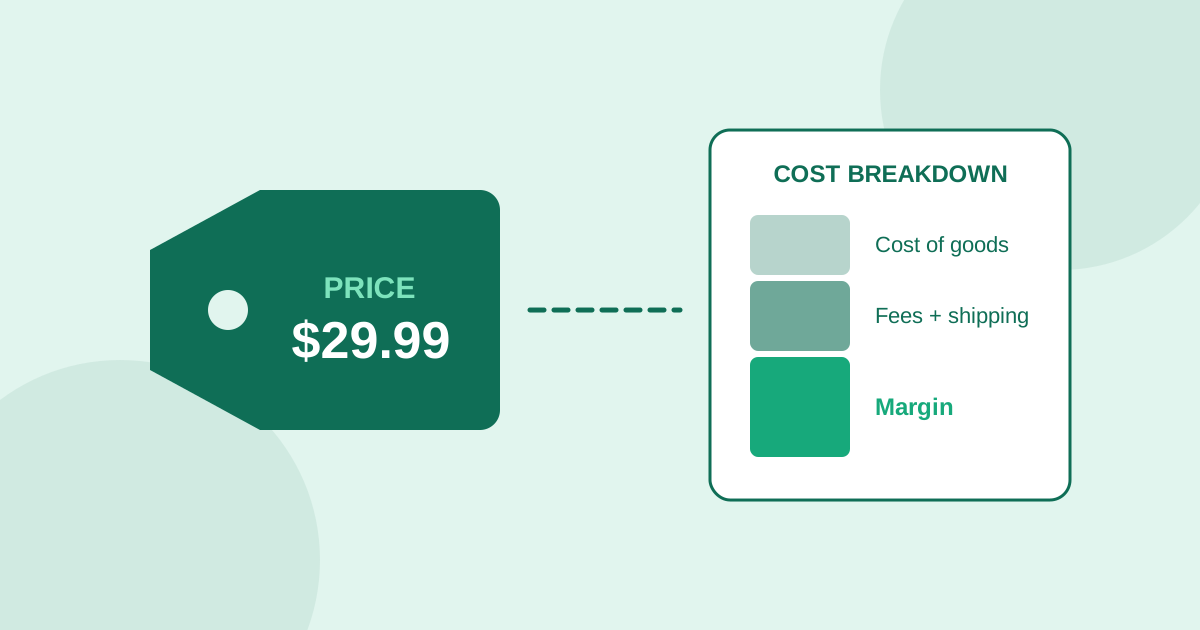
Most validation advice stops one step too early. You find a complaint that repeats across Reddit, Amazon reviews and YouTube comments, you confirm people are actively looking for a fix, and you conclude the idea is validated. It is not, yet. What you have validated is demand. What you have not validated is whether you can serve that demand at a price buyers will pay and still keep enough of each sale to run a business. Plenty of products with real, well-documented demand lose money on every unit, and the founder only discovers it after the first inventory order has landed.
This guide covers the second half of validation: confirming the price and the margin. It walks through how to find the price buyers already expect, how to build an honest per-unit cost picture, how to read a break-even number, and how to decide whether the math is good enough to proceed. None of it requires a spreadsheet model with forty tabs. It requires about six numbers and the discipline to not round them in your own favor.
Why demand validation and margin validation are different questions
Demand validation asks whether a problem is real, frequent and painful enough that people want a solution. Margin validation asks whether the solution can be delivered profitably through the channel you plan to sell on. The two can disagree completely. A sharp, widely shared complaint about a ten-dollar product category can be impossible to build a business on, because a ten-dollar price leaves almost nothing once a marketplace fee, a fulfillment fee and the cost of acquiring the customer are taken out. A duller complaint in a sixty-dollar category can be a comfortable business with the same effort.
The reason founders skip this step is that the margin math feels like something you do later, once the product exists. In practice the order matters the other way around. The price ceiling and the fee structure of your chosen platform decide how much you can afford to spend making the product, and that decides what the product can be. Running the numbers after you have committed to a supplier quote means you are checking whether a decision you already made happens to work, rather than using the numbers to make the decision.
Step one: find the price buyers already expect
You do not get to choose your price in a vacuum. Buyers arrive with a range in mind, set by the products they have already seen. The quickest way to find that range is to list the five to ten closest competing products on the channel you plan to sell on and write down their actual selling prices, not the crossed-out list prices. Most categories cluster into two or three clear bands: a budget tier, a mainstream tier and a premium tier. Your product will be judged against whichever band its listing looks like it belongs to.
Then read the reviews for price language specifically. Complaints such as not worth the money, fine for the price or I would have paid more for one that actually lasted tell you far more than the price tags do. The first says the band is already stretched. The second says buyers have low expectations and are tolerating a mediocre product because it is cheap. The third is the one worth hunting for: it is a buyer telling you, unprompted, that a better version could sit in a higher band. Cross-source complaint research is useful here for the same reason it is useful in demand validation. If the same willingness to pay more for durability, fit or a missing feature shows up in marketplace reviews, in a subreddit and in video comments, it is a pattern rather than one generous reviewer.
Step two: build the honest per-unit cost stack
Once you have a realistic price, subtract everything that comes out of it before it reaches you. There are four layers, and the mistake is almost always leaving one of them out. The first is cost of goods: what you pay per unit to have the product made and delivered to wherever it ships from, including inbound freight, duties and packaging, not just the factory quote. The second is platform fees: marketplaces and payment processors each take a cut, and the structure differs by channel. Selling through a marketplace with its own fulfillment, selling on a handmade and craft marketplace, and selling through your own store each produce a different fee line on the same product at the same price. Fee schedules change, so always check the platform's current published rates rather than a figure from an old blog post, including this one.
The third layer is shipping to the customer, if your channel does not already bundle it into fulfillment fees. The fourth is the one most often ignored: the monthly costs that exist whether you sell one unit or a thousand. Advertising, storage, software subscriptions and listing tools are not per-unit costs, but they have to be paid out of per-unit profit, which is why they belong in the calculation from the start. What is left after the first three layers is your gross profit per unit. What is left after spreading the fourth layer across your expected sales is your net profit per unit, and that is the only number that tells you whether the business works.
Step three: read the break-even number, not just the margin
A margin percentage on its own is easy to feel good about. A break-even figure is harder to argue with. Break-even units per month is simply your monthly fixed costs divided by your gross profit per unit: the number of sales you need before the first dollar of actual profit appears. Here is a worked example with deliberately round, illustrative numbers. Suppose you plan to sell at $29.99, your landed cost of goods is $8.50 and platform fees on that sale come to $9.00. Your gross profit is $12.49 per unit. If advertising and tools cost you $600 a month, you need to sell 49 units a month just to cover them. At 100 units a month you keep $649, about $6.49 per unit, a net margin of roughly 22 percent.
Now run the scenario most new sellers actually face: a competitor undercuts you and you drop the price to $24.99. Say fees fall slightly to $8.25. Gross profit per unit drops to $8.24, break-even rises from 49 units to 73, and at the same 100 units a month you keep $224, about 9 percent. A five-dollar price cut, roughly 17 percent off the sticker, removed about two thirds of the profit. That sensitivity is the real finding. If your plan only works at the top of the price band and with optimistic sales volume, you have not validated a business, you have validated a best case.
Step four: decide what the numbers are telling you
There are three honest outcomes. The first is that the margin holds up at a realistic price and a conservative sales estimate, with room left to absorb a price cut or a rise in ad costs. Proceed. The second is that the margin only works under favorable assumptions. That is not a no, it is a prompt to change one input: negotiate the unit cost, move the product into a higher price band by solving the complaint buyers said they would pay more for, bundle it to raise the order value, or pick a channel with a different fee structure. The third outcome is that no reasonable combination of inputs produces a margin worth the risk. That is a genuinely valuable result. It cost you an afternoon instead of an inventory order.
Be especially strict with the sales volume assumption, because it is the input founders most often invent. If you are estimating from a competitor's sales, treat any estimate as a range rather than a fact. UserConcern's own Sales Estimator states a typical variance of plus or minus 20 to 30 percent on its estimates for exactly this reason, and you should run your break-even against the low end of whatever range you are working from, not the middle.
Running the check in UserConcern
The Profit Calculator in UserConcern is built for this specific check. You enter the product name, choose the platform (Amazon FBA, Etsy or Shopify DTC), and fill in the sale price, your product cost, shipping to the customer, your monthly fixed costs and, optionally, the monthly units you expect to sell. It returns a verdict, net profit per unit, net margin, return on investment, a fee breakdown for the platform you chose, break-even units and break-even revenue per month, and a short list of recommendations. The companion Sales Estimator takes an Amazon ASIN or product URL and estimates monthly sales for an existing listing, which gives you a grounded starting point for the units field instead of a guess.
The most useful way to use it is not to run it once. Run it at your target price, then at the bottom of the price band you found in step one, then with your unit cost ten to fifteen percent higher than quoted, since first quotes rarely survive contact with freight and packaging. If the verdict survives all three runs, you have a margin you can trust. If it flips on the second run, you know precisely which assumption your business depends on, and you know it before you have spent anything.
Demand tells you a product deserves to exist. Margin tells you whether you can afford to be the one who makes it. Do the pain-point research first, because without real demand the math is irrelevant, then put the price and cost stack through the same honesty test before you place an order. The two checks together take less time than writing a supplier brief, and they are the difference between launching a product and launching a business.
Frequently asked questions
What is a good profit margin for a physical product?
There is no single number, because it depends on your channel, price point and how much you rely on paid advertising. A more reliable test than a target percentage is resilience: the margin should still be positive after a realistic price cut, a modest rise in unit cost and a conservative sales estimate. A margin that only works in the best case is not a validated margin.
How do I calculate break-even units for a product?
Divide your monthly fixed costs (advertising, storage, software and similar) by your gross profit per unit, which is the sale price minus cost of goods, platform fees and shipping to the customer. The result is how many units you must sell each month before you make any actual profit. Round up, and compare it against a conservative sales estimate rather than a hopeful one.
Should I validate price before or after validating demand?
Demand first, then price and margin, and both before you commit to inventory. Without real demand the margin math does not matter. But a confirmed pain point is not enough on its own: the price buyers expect and the fees on your chosen platform decide how much you can afford to spend making the product, so the margin check should shape the product rather than follow it.
How do I find out what buyers are willing to pay?
List the real selling prices of the closest competing products to see the price bands in the category, then read reviews for price language. Phrases like fine for the price or I would have paid more for one that lasted reveal whether buyers feel the band is stretched or whether a better product could sit in a higher tier. Look for the same signal across more than one source before relying on it.
Does UserConcern include a margin calculator?
Yes. The Profit Calculator takes your sale price, product cost, shipping, monthly fixed costs and expected units for Amazon FBA, Etsy or Shopify DTC, and returns net profit per unit, net margin, ROI, a fee breakdown and break-even units and revenue. A companion Sales Estimator estimates monthly sales for an existing Amazon listing from its ASIN or URL.
More articles
 E-commerce
How to Use AI for Amazon Product Research (Complaint Mining Guide)
Stop guessing what to sell. Here's how to use AI to mine real customer complaints and validate Amazon product ideas before you invest a cent.
Read article → E-commerce
How to Validate an Etsy Product Idea Before You Make a Single Item
Handmade and print-on-demand sellers can't afford to guess. Here's how to validate an Etsy product idea using real buyer complaints before you spend on materials or inventory.
Read article →